

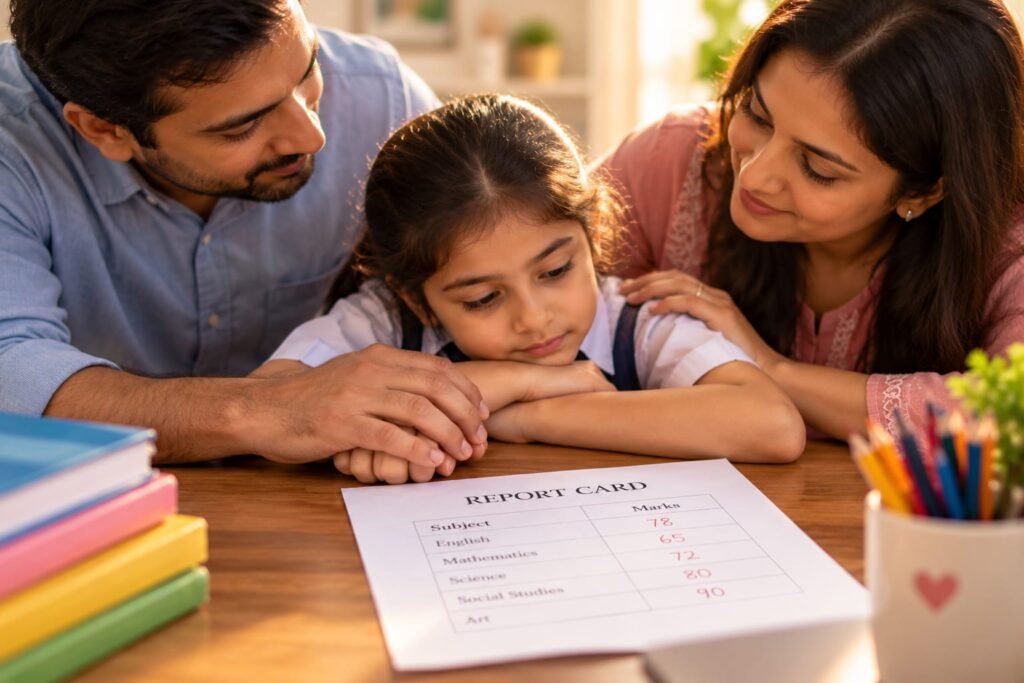
When our children come home with their report cards are they excited to share their achievements –or quietly wishing that parents will notice their efforts, growth, and courage behind them too?
“Kitne marks aayey?’’
For many children, this is the very first question they hear after an exam. Before anyone asks what they learned or how they feel, their marks take centre stage. A child scores 85%, and we ask about the missing 15%. Slowly, they learn a dangerous lesson: their efforts don’t matter as much as their achievements.
Without realizing it, we teach them that being good is not enough. They must always be better.
Before We Ask About the Marks, Let’s Ask Ourselves
As parents , we all want our children to succeed. But have we ever paused to think about
what our children experience when they bring home a report card. When our child loses
marks, do we become curious about the difficulty they faced, or do we immediately point
out what went wrong Do our children feel comfortable telling us that they failed at something, or are they afraid
of disappointing us?
These questions are not meant to make us feel guilty. Parenting is not about getting
everything right; it is about becoming more aware of the messages we send through our
everyday reactions.
A child may not remember every mark they scored, but they may remember the look on our
face when they showed us their result. They may remember whether we listened,
compared, encouraged, or criticised.
So, the next time a report card comes home, perhaps we can begin with three simple
questions:
“How do you feel about your result?
What did you find difficult?
How can I help you?”
Sometimes, the most valuable lesson a child learns from a report card is not about marks at
all. It is whether they can make mistakes, keep learning, and still feel loved.
The Trap of “Never Enough”
Every parent wants their child to succeed and have a secure future. But when academic performance becomes the sole measure of a child’s worth, healthy encouragement morphs into heavy pressure.
Curiosity Dies: Instead of learning to discover, children study merely to avoid criticism.
Fear Replaces Confidence: A child who once loved asking questions stops speaking up, terrified of making a mistake.
The Weight of Silence: Pressure isn’t always yelling. It is deeply felt in subtle sighs, disappointed looks, and the heavy silence that follows a “poor” result.
The Hidden Message in Comparisons
“Look at your cousin. She always scores above 90%.”
We think these statements motivate. Instead, the child hears: “I am not good enough as I am.” Repeated comparisons teach children that a parent’s love and acceptance must be purchased with high test scores. This completely ignores their individuality—a singular focus on math scores blinds us to a child’s unique gifts in art, empathy, or creative problem-solving.
Ways to Raise a Healthy Learner
How can we redefine success at home? Here is how to build resilience alongside intelligence:
1. Praise the Process: Appreciate the late nights and the hard work. Acknowledge their effort when they tackle a difficult problem, regardless of the final score.
2. Replace Comparison with Curiosity: Instead of asking, “Why didn’t you get an A?” try asking, “Which part of the paper was the trickiest for you?”
3. Normalize Mistakes: Make your home a safe place to discuss failures. Listen first, and help them figure out what to do differently next time without shame.
4. Celebrate Character: Loudly applaud their kindness, honesty, courage, and teamwork. Value extends far beyond numbers.
5. Protect “Kid Time”: Play, hobbies, and rest are crucial for brain development. They are not distractions from learning; they are a core part of it.
The Ultimate Takeaway
One day, our children will face real-world challenges—relationships, career setbacks, and tough decisions—that no exam can prepare them for. They will need the emotional strength to fail and the courage to begin again.
The next time you see a report card, celebrate the wins, discuss the gaps, but always remember the person holding the paper.
Let us raise children who feel valued , not evaluated . Because a report card may reflects grades , but it can never measure their worth

