Tag: TV Watching

Career Confusion in Teenagers: How Parents Can Help Without Adding Pressure

Your child doesn’t need to have their entire future figured out today. They need the confidence, support, and freedom to discover it.
“Beta, 10th ke baad kya karna hai?”
“Science loge ya Commerce?”
“Engineering, Medical, CA, ya kuch aur?”
For many Indian teenagers, these questions begin long before they understand their own interests, strengths, or aspirations. What starts as a simple conversation about the future can gradually become a source of stress, anxiety, and self-doubt.
Career confusion is not a sign that a child lacks ambition. Sometimes, it means they haven’t had enough opportunities to understand themselves.

Why Are Teenagers So Confused About Their Careers?

Today’s teenagers have more career options than ever before. Along with traditional careers such as engineering, medicine, and commerce, they can explore technology, design, sports, entrepreneurship, digital media, psychology, and many emerging fields.

But more options do not automatically mean more clarity.

Here are three common reasons behind career confusion.

1. Pressure to follow the crowd

When friends choose Science, a student may feel compelled to do the same. When relatives praise a particular profession, children may believe that choosing anything else means settling for less.

They start asking, “What will people think?” instead of “What is right for me?”

2. Fear of making the wrong decision

Many students believe that one decision after Class 10 or Class 12 will determine their entire future. This fear can make them overthink every option or avoid making a decision altogether.

They need to understand that career decisions matter, but learning, experience, and changing interests can also open new paths.

3. Limited self-awareness and exposure

A student may know the names of popular professions without understanding what the work actually involves.

They may choose a career based on salary, social status, family expectations, or what they see online rather than their interests, abilities, values, and willingness to develop the required skills.

What Can Parents Do Differently?

Parents play an important role in career development. However, supporting a child is different from deciding their future for them.

Here are four practical steps parents can begin today.

1. Replace interrogation with curiosity

Instead of repeatedly asking, “What do you want to become?”, try asking:

  • Which subjects or activities make you curious?
  • What kind of problems do you enjoy solving?
  • What activities make you feel engaged and confident?
  • What would you like to explore before making a decision?

These questions help children reflect instead of feeling pressured to provide an immediate answer.

2. Focus on strengths, not just marks

Marks are useful indicators of academic performance, but they do not tell the complete story of a child’s potential.

Observe how your child thinks, communicates, creates, solves problems, works with others, and responds to challenges.

Encourage them to explore their strengths while also recognising the skills they need to develop.

3. Give them opportunities to explore

Career clarity grows through experience, not just conversations.

Encourage your child to attend career talks, explore reliable career assessments, speak with professionals, try relevant projects, or participate in workshops.

Help them understand the education, skills, daily responsibilities, and realities associated with different careers.

4. Build confidence before demanding clarity

A child who fears criticism may hide their doubts or choose an option simply to please their parents.

Create an environment where they can say, “I’m confused,” without feeling that they have disappointed you.

Your message should be: “We don’t have to know every answer today. We will explore the options together.”

A Simple Activity to Start Today

Set aside 15 minutes with your child. Keep phones away and discuss three questions:

  1. What are three activities or subjects you genuinely enjoy?
  2. What are two careers you would like to understand better?
  3. What is one small step we can take this week to explore one of them?

Do not evaluate their answers immediately. Listen, ask follow-up questions, and agree on one practical next step.

Repeat this conversation periodically as your child learns more about themselves.

The Real Goal Is Career Readiness, Not Just Career Selection

As parents, we naturally want our children to be successful and secure. But the most valuable support we can offer is not a ready-made career decision.

It is the ability to understand themselves, evaluate choices, develop skills, adapt to change, and make informed decisions with confidence.

At Rise Together — The Parent & Student Growth Journey, I believe that career clarity begins with self-awareness, grows through exploration, and becomes stronger when parents and children work together.

Your child may not know what they want to become today. That is okay.

Don’t rush to decide their future. Help them discover it.

Subodh Langde is a Parent & Student Growth Coach who helps Indian families with teenagers in Classes 9–12 build confidence, improve communication, strengthen study habits, and approach career decisions with greater clarity.

Start a conversation with your child today. Their future needs your guidance—not your pressure.

Digital Exposure & Experiencing Nature -The Balance Our Children Need

Digital Exposure & Experiencing Nature -The Balance our children need!


One of the perks of working as a parenting coach and counselor is being able to pull from your own experiences, both as a father and of course as a kid. This forces you to realize just how much has changed since your childhood. As a latchkey kid who thrived on fresh air, Extensive Playtime, and family dinners, I look at today’s generation of tech-savvy tots and wonder when — and, more importantly, how — this transformation occurred.

Today’s childhood is getting trapped in a world of gadgetry!

My first “owned” Gadget was at 21. A cellphone shared by my sister  and me, but operated by my Father because ‘you all are young to use it and hey it is expensive!

The most telling difference between my childhood and the present, however, is today’s lack of time. Time to explore, time to experiment, time to be a child – which means, most importantly, time to play.

Mr.COVID having added to it all!

The Kids of the big cities and now rapidly increasing in Towns as well are living in a ‘citified’ environment- lack of connection with Nature.

A child, any growing child needs stimulation-

The Gadgets, The screens, The schools and even the parents are however becoming Overwhelming rather than stimulating to a child’s sensory demands.

The Child may have all the consumption but is steadily being devoid of the Engagement.

We are teaching our children how to make a living, but not life!

We’ve been telling them how we have made our way to the moon and back, but have trouble letting them meet the new neighbor.

This boon of ‘Digital Fidgeting’ has taken away the ‘Friendly Neighbourhood’.

Quite a Paradox is it not!

So, is there a way back from this? Should we reconsider?

Should we BAN the Digital world from a child’s life?

As a Parenting Coach, I have counseled and seen many cases where extremes have failed!

The answer one feels is in Division of the day, week, month.

Slowly and steadily compartmentalize the mind of the child to understand that the week is going to be designed into 2 parts.

Balanced between Boons of Digital Exposure to The abundance of Nature.

Children nowadays have many more opportunities to literally see the world than we had. In our time, we could only read about different countries and their culture through books. Now, there is digital media to support that experience and of course, not to mention the opportunity to travel and experience first-hand. so why not have a balance.

When you introduce your little one to animals and their sounds on the television, ensure you take her/him to the zoo to see those animals in their natural habitat and hear those sounds real in the next 2 days. This makes 2 days of both offering them Digital Exposure and Experiencing Nature.

When your child watches an animal animation fiction on the Tele, that same week Arrange for a trip to an Animal Café for her/him to feel the warmth and compassion of the animals of different kinds.

The above examples will ensure that a child will consume the ways and means of an animal kingdom, species, and their ways via digital boon and then experience the engagement when they visit such places and feel their sensory demands being satisfied.

A perfect example of balance and harmony of

Look, Listen & feel.

This can be tried in all aspects of the child’s interest. Now the child will know and appreciate the difference between learning from digital media and being and feeling in the real environment. The child enjoys and appreciates the worth of both aspects.

Woh kehte hain na, “ बच्चों को ये सिखाना चाहिए कि कैसे सोचें , ना कि क्या सोचें।

To me, this will create an environment for the child to recognize the balance between Consumption and Engagement.


-Santosh Bakhshi

A Life Coach & A Learning Father!

Moving from Digital to Development

Moving from Digital to Development


In today’s digital age, it is not very uncommon to find even toddlers using gadgets. Many parents try to please their children by giving them tablets and phones so that they are kept busy and entertained. But have you ever thought that a toddler needs more human interaction than with an AI?

A child’s early developing stage is until the age of 6. Hence, it is very essential that you do not let him or her be dependent on gadgets.

Do not forget that every child needs attention and gadgets are no substitution to it. Here are few things that you can do to help your child move from the digital to the development stage.

  • Get Real Games: 3D games are fun and attractive, but they also harm your child’s mental growth. So, instead of downloading a game on your tablet or phone, get your child a game appropriate for his or her age. Games which will help your child in learning and at the same time have fun with it.


  • Spend More Time with your Child: It is very important that you try to spend as much time as you can with your child. The more time spent with your child, the more disinterest your child will be with the gadgets.


  • Encourage Creativity: Every child at the toddler stage loves to draw (or should I say scribble). Encourage your child to be creative and let him or her draw or scribble. Appreciate your child for what he or she has created.


  • Get Them Involved: You may want to keep your child away from the household work, but the truth is by keeping your child involved during your household chores can help you interact with him or her better. It also makes it easy for them to learn quickly and easily.


Do not let gadgets hinder your child’s growth. Enjoy this stage with your child because time does not turn around.


Happy Parenting!!!

Arti A

Parenting Coach


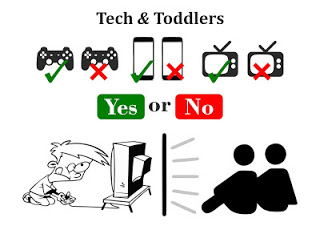
Tech ‘N’ Toddlers

Too much of anything is not good and this also stands true about exposure of Media available today to kids. I have been receiving numerous queries from parents in this regard:

  • What shall be the permissible limit to play video games?
  • To which extent shall we allow our kids to watch TV
  • How to differentiate their viewing of educational videos from entertainment videos?

Good part about this problem is that parents at least started realizing that problem exists. Let’s  discuss how to address this issue.

Rules for TV watching:

  1. Separate Viewing from Chewing:

If you allow your child to watch television while eating meal, it might make your child become heavily dependent upon it. Research shows that the particular combination of eating while watching something is a strong motivator to get your kids hooked to TV.

  1. Decide What is allowed to be watched:

Children can easily hook upon a movie or a TV series that aren’t meant for them. This is why it is imperative that you decide what is best for your child. It shall be age appropriate.

  1. Set a Family Time for watching TV

Have time when you and your kids can enjoy a fun family movie once in a while. This will give you the chance to interact with your kids and spend some quality time together.

  1. Kid’s room should not have the TV

TV does keep kids out of your way when you’re busy, but giving your kids a separate television for their rooms is simply asking for trouble. Your kids are more likely to find and watch inappropriate programs and you will not be able to control what they watch, and the amount of time they spend on the TV.

Rules for Video Games:

  1. Having fun with video games should only be allowed after children have taken care of other responsibilities. For example, parents are strongly advised to set a rule that video games can only be played after homework is completed (and completed with effort).
  1.  Access to computer/video games should be viewed as an earned privilege, not an automatic right.
  2.  Keep computers and gadgets out of a child’s bedroom. It is much easier to limit computer gaming (and monitor online activity) if computers are in open spaces or family rooms. To ensure children not getting addicted to computer games this is perhaps the first step parents should take.
  3. Children addicted to computer games will happily play for hours at a time. Although this can provide valuable free time for busy moms and dads, parents need to make sure that computer games are not their child’s primary activity or form of entertainment.

What’s Recommended?

  • Toddlers up to 18 months old: No Screen time
  • Toddlers up to 18 months to 24 months: Some Screen time with a parent or caregiver.
  • Preschoolers: Not more than 1 hour a day of educational program, together with a parent or other caregiver who can help them understand what they’re watching.
  • Children above 5 years: Parents should place consistent limits on screen time, which includes TV, social media and video games.


Board Games & Outdoor Games:

Encourage your child to get engaged in other activities that are more beneficial to them in both ways mentally and physically. Kids should be doing things that are intellectually enriching: playing with board games, playing with dice, playing with things that will improve their motor skills, reading skills, logics, visual ability & concentration. You need to have at least 4-5 different board games at home, 1-2 single player games and 2-3 multi-player games.

Spare time to play with your child. Cherish these moments.

Manish Sharma

Parenting Coach