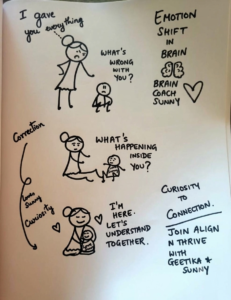
From “What’s wrong with you?” to “I’m here. Let’s understand it together.”
By Brain Coach Sunny
Imagine this.
It’s 8:15 in the morning.
One child can’t find their socks. Another hasn’t finished their homework. The school bus is almost here. The lunchbox is still open. Your phone is ringing, the milk is boiling, and somebody has just announced that they don’t want to go to school today.
And then you hear yourself say…
“WHAT IS WRONG WITH YOU?”
Silence.
A little face looks down.
You continue getting everything ready. The bus arrives. The day moves on.
But later, perhaps while folding clothes or washing a cup, you remember that little face.
And a quiet voice inside you asks, “Did I hurt my child?”
Dear Mumma, if you have ever been there, come, sit beside me for a moment. ❤️
No judgement. No lecture. No parenting report card.
Just two human beings trying to do their best.
Because motherhood is not always a beautiful photograph with matching clothes and happy smiles. Sometimes, it is messy hair, unfinished work, tired eyes, big feelings and a heart that loves deeply but doesn’t always know what to do next.
And sometimes, the smallest change in a question can open the biggest door in a relationship.
Let’s explore three questions together.
1. “What’s wrong with you?” — Or am I simply overwhelmed?
We say these words in different ways.
“Why can’t you listen?”
“Why are you so careless?”
“Why can’t you be like your cousin?”
“Why do you always create problems?”
Most mothers don’t wake up in the morning planning to hurt their children.
They wake up planning to take care of them.
They want their children to be educated, confident, safe, successful and happy. They worry about marks, competition, screen time, friendships, safety and the future.
In today’s India, parenting can feel like running a race in which the finish line keeps moving.
One child has tuition. Another has swimming. Someone else is learning coding at age eight!
And somewhere along the way, a mother starts wondering, “Am I doing enough?”
When fear becomes louder than connection, even a small mistake can feel like a big problem.
A forgotten notebook becomes carelessness.
A tantrum becomes disrespect.
A poor mark becomes a prediction of the future.
A child’s difference becomes something to correct.
But what if we paused for a moment?
What if the child isn’t deliberately trying to make your day difficult?
Perhaps they are tired. Perhaps they are struggling to express an emotion. Perhaps they need clearer boundaries, more practice, reassurance or support.
We cannot know what is happening simply by looking at a behaviour. But we can begin by getting curious instead of jumping to conclusions.
A small Brain Coach Sunny reminder: Behaviour deserves understanding, not instant labelling.
And here’s something equally important.
Sometimes, the person who needs understanding first is YOU.
Perhaps you are exhausted. Perhaps nobody asked how your day was. Perhaps you have been carrying ten responsibilities and smiling through all of them.
You are a human being, Mumma. Not a machine with a saree, a lunchbox and unlimited patience!
You deserve care, too.
Your reflection question:
When your child tests your patience, what might you need in that moment — rest, help, reassurance, or a little kindness towards yourself?
Take a breath before you answer.
You may discover that the anger is only the top layer of a much deeper feeling.
And discovering that is not weakness. It is the beginning of awareness.
2. “What’s happening inside you?” — The beautiful art of getting curious
Imagine your child comes home from school, throws the bag on the floor and says, “I hate school!”
Your first response might be:
“Don’t talk like that! You have everything. Other children would love to have your opportunities.”
But what if you tried something different?
You sit beside your child.
You put your phone away.
And you ask gently:
“Something happened today, didn’t it? Would you like to tell me?”
Perhaps your child says another student laughed at their answer.
Perhaps they felt left out during a game.
Perhaps they couldn’t understand a lesson and were afraid of looking foolish.
Or perhaps they simply had a difficult day and don’t yet have the words to explain it.
You don’t have to solve everything immediately.
You don’t have to become a detective, therapist, teacher and motivational speaker in the same five minutes!
Sometimes, you can simply listen.
“Tell me more.”
“That sounds difficult.”
“I’m glad you told me.”
“Would you like a hug, some help, or a little time?”
These small responses tell a child something precious:
My feelings are welcome here. I don’t have to hide them to be loved.
This does not mean saying yes to every demand or allowing every behaviour. Children still need boundaries, responsibility and guidance.
It means offering those boundaries without making the child feel that their worth is in question.
And here’s where understanding your child’s individuality matters.
One child may talk through a problem. Another may need quiet time before opening up. One may learn best by doing. Another may love words, stories or pictures.
Some children express themselves loudly. Others become very quiet.
There is no single conversation that works perfectly for every child.
Get to know the little person in front of you.
Notice what lights them up. What frustrates them. What they keep practising without being asked. What they find difficult. What makes them feel safe enough to try again.
Their interests can offer clues to their strengths. Their struggles can show you where they need support.
Your child is not a school report waiting to be improved.
Your child is a person waiting to be understood.
Your reflection question:
If your child could tell you one thing without fearing your reaction, what do you think they would want you to understand?
Don’t rush to answer for them.
Create the space in which they can answer for themselves.
You might be surprised by the little world that opens up.
3. “I’m here. Let’s understand it together.” — The courage to repair
Now, let’s talk about the moments we wish we could take back.
The time you shouted.
The comparison you made.
The promise you forgot.
The day your child wanted to show you a drawing, but you were too busy to look.
The evening you reacted to a small mistake because you were carrying a very big day.
Dear Mumma, you cannot go back and change yesterday.
But you can choose what happens next.
You can walk into your child’s room, sit beside them and say:
“I’ve been thinking about what happened earlier.”
“I was upset, and I spoke harshly. I’m sorry.”
“You didn’t deserve to be spoken to that way.”
“Next time, I’ll try to handle my feelings differently.”
“Can we talk about what happened?”
Notice something beautiful here.
You are not saying that every rule was wrong.
You are not giving up your role as a parent.
You are showing your child that people can take responsibility, apologise and try again.
You are teaching emotional courage through your own actions.
And perhaps your child will learn to say, “I’m sorry, too,” when they make a mistake.
Not because they are afraid of losing your love, but because they understand the value of repairing a relationship.
Connection is not about never having a difficult moment. It is about learning how to find your way back to each other.
And now, Mumma, there is one more person who deserves an apology.
You.
Yes, you.
The woman who is still thinking about that one impatient sentence.
The mother who keeps replaying yesterday’s mistake while preparing today’s breakfast.
The woman who loves her children so much that she sometimes forgets she is learning, too.
Can you place your hand on your heart and say:
“I am learning.”
“I am allowed to make mistakes.”
“I can take responsibility without hating myself.”
“I can do better without calling myself a bad mother.”
“I deserve the same kindness I want to give my child.”
Please remember this: forgiving yourself does not mean pretending that nothing happened. It means acknowledging what happened, repairing what you can and choosing a more helpful response next time.
Guilt can remind us to make things right. Shame tells us that we ourselves are wrong.
You can learn from your actions without turning them into a verdict on your entire motherhood.
You don’t need to punish yourself forever to prove that you love your child.
Your reflection question:
What is one moment in your parenting journey that you are ready to learn from, make amends for, and finally stop using to punish yourself?
Give yourself permission to begin again.
Your child is growing.
And so are you.
A little game for Mumma and Me
Tonight, try a five-minute connection game.
No teaching. No correcting. No checking homework.
Just five minutes of being together.
Take turns completing these three sentences:
❤️ I feel loved when…
🌱 Something I wish you understood about me is…
🤗 One thing we can do together this week is…
Let your child answer first if they wish. Listen without arguing with their feelings. You can share your own answers, too.
If the conversation feels awkward, smile. You’re learning a new language together — the language of understanding.
And if your child doesn’t want to talk today, that’s okay. Connection can also begin with drawing, playing, walking, reading or simply sitting beside each other.
Small moments, repeated with care, can make a meaningful difference.
My promise as Brain Coach Sunny
My mission comes from a deeply personal place.
I know what it feels like to receive things and still long to feel understood, supported and appreciated.
I know how easily self-doubt, fear and feelings of not being enough can follow us into adulthood.
And I believe every child deserves the opportunity to grow up discovering their worth, their strengths and their unique way of being in the world.
I want to help mothers understand their children’s individual needs, recognise their gifts, and nurture relationships where children feel seen, heard, loved, valued, appreciated and understood.
Not through perfect parenting.
Not through endless pressure.
But through awareness, connection, curiosity and love.
Because our children don’t need us to build a childhood in which nothing ever goes wrong.
They need us to help them discover that when things do go wrong, they can ask for help, learn, repair and begin again.
And mothers deserve that same grace.
So, the next time your child struggles, remember our three questions:
1. What’s wrong with you?
Pause. Notice your own feelings before reacting.
2. What’s happening inside you?
Get curious. Listen. Discover what your child might need.
3. I’m here. Let’s understand it together.
Connect. Guide. Repair. Grow together.
Three questions.
One relationship.
A thousand opportunities to begin again.
And perhaps, one day, your child will grow up and remember:
“My mother wasn’t perfect. But she tried to understand me. And when she made mistakes, she came back, held my hand and tried again.”
Dear Mumma, that is a beautiful legacy to leave.
You are not just raising a child. You are helping shape the voice they may one day use to speak to themselves.
Let that voice be kinder.
Let that voice be stronger.
Let that voice say, “I am worthy of love, even when I make mistakes.”
And let that journey begin with you.
With love, a smile and a little more kindness for yourself,
Brain Coach Sunny
Decode before you develop. Connection before correction.
One final question for you, Mumma:
What is one sentence you wish someone had said to you when you were a little girl — and could you say those words to your child today?