Think back to your own childhood. Was there a word people used for you again and again? Shy. Lazy. Slow. Careless. Do you still hear it in your head today?
I ask because I see its effect every day in my Kids Workshop.
Recently, a boy named Kunal told me, “Mam, I can’t say these lines on stage. I will forget.” Before I could answer, his brother Krish said, “Don’t worry, Mam, I’ll do his part also. He is bhulakkad.”
“Who said this?” I asked.
“Everyone. My parents.” Krish replied.
Kunal had heard the word so often that even his brother treated it as a plain fact. I stayed beside him, and he spoke three lines on that stage. The room applauded. For a boy who believed he would always forget, those three lines were proof that the label was wrong.
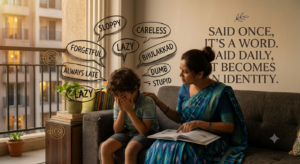
I wasn’t shocked by what I heard, because Kunal’s story is common. Children are called slow, dumb, careless, kalu, golu, chotu, hyper, talkative, lazy, and most of the time nobody means harm. It’s a joke, or a moment of frustration, or a hopeful push to make the child try harder. But a child doesn’t hear a joke or a strategy. A child hears a verdict from the people they trust most. Said once, it’s a word. Said daily, it becomes an identity. And when the words are spoken in front of relatives, friends or classmates, they stop being a label and become humiliation, which goes straight to the child’s self-esteem.
Schools can add to this without meaning to. When results are the easiest measure, the topper becomes the default choice for every co-curricular and extra-curricular activities, as if the highest scorer must be best at everything. Meanwhile, the child who writes beautifully or has a voice that could hold a hall is never asked. After a while, that child concludes, I’m not good at anything.
Even compliments can do damage. A friend of mine often says proudly, whenever her elder daughter is praised, “Yes, she looks like me. Per kya kare, choti wali to apni bua par hi chali gayi.” (But what to do, the younger one took after her aunt.) Imagine hearing that as the younger child. She may start wondering, Is something wrong with me? She may even resent her aunt and envy her sister. One casual line is enough to plant that doubt.
And the doubt grows. A child who is told who she is, again and again, starts to believe it. Her self-esteem drops, and her confidence shrinks with it. Speaking in front of others becomes frightening, and she learns that staying quiet is safer than trying. Years later, she is still chasing other people’s approval to prove the label wrong.
“A child may forget the occasion, but the words repeated by the people they trust can stay with them for years.”
The good news is that words can also build a child. So don’t humiliate the child, even when you are frustrated, because humiliation gets in the way of the child’s self-esteem and confidence. Instead of saying “You’re lazy and useless” (which attacks the child’s identity and hurts them), try “Your homework is incomplete, let’s make a plan to finish it” (which teaches a skill and protects the child’s dignity). We can also look for the strength inside the trait, because the “talkative” child may be a future speaker and the “shy” one a thoughtful observer. And we can share the stage, so that every child gets a chance to shine, not just the one who always wins.
So here is the question I leave with every parent and teacher: are we helping our children discover who they are, or are we repeatedly telling them who we think they are?
Dr. Daisaku Ikeda, a Japanese educator, said it best: “Every child is born with a unique mission. Our responsibility as parents and educators is not to make them like someone else, but to help them discover who they truly are and bring forth their unique potential.”
Kunal is no longer bhulakkad. He is a boy who stood on a stage and spoke.
Which word will your child carry?