Understanding Child Development: A Parenting Coach’s Perspective
If there’s one thing I’ve learned from years of working with families, it’s this: child development isn’t a straight line. It doesn’t move neatly from one milestone to the next. It’s messy, emotional, beautiful, and sometimes deeply confusing.
Parents often come to me worried. “Is my child behind?” “Why is she suddenly so emotional?” “He was so cooperative before — what happened?”
The truth is, development is not just about height, weight, or academic progress. It’s about the slow shaping of a human being — their thinking, emotions, behavior, relationships, and sense of self. And that shaping happens in layers.
Development Is More Than Milestones
We tend to measure children by visible markers: first words, first steps, first report card. Those matter, of course. But underneath those milestones, something far more important is happening.
A toddler learning to walk is not just building muscle strength. They’re building confidence.
A preschooler asking “why” for the hundredth time isn’t being difficult. They’re wiring their brain for curiosity.
A teenager challenging rules isn’t rejecting you. They’re forming an identity.
When we reduce development to checklists, we miss the deeper story.
Emotional Development: The Foundation We Often Overlook
In my sessions, I often see parents focus heavily on academics. “How do I improve focus?” “How do I make my child score better?” But before concentration and performance comes emotional safety.
A child who feels safe — truly safe — learns better. They take risks. They bounce back from failure.
Emotional development begins long before children can explain their feelings. It begins when a baby cries and someone responds. It grows when a parent names a feeling: “You’re upset because your toy broke.” It strengthens when a child’s emotions are acknowledged instead of dismissed.
Children don’t need perfect parents. They need emotionally available ones.
Cognitive Growth Happens in Everyday Moments
We sometimes imagine learning as something that happens at a desk. But real cognitive development happens while cooking together, solving sibling conflicts, building with blocks, or even getting bored.
Yes, bored.
Boredom pushes creativity. It nudges problem-solving. It invites imagination. When every moment is filled with structured activity, we unintentionally rob children of the chance to think independently.
Simple conversations at dinner can strengthen reasoning skills more effectively than extra worksheets.
Social Skills Start at Home
Before children learn how to make friends, they learn how to relate to you.
Do they feel heard?
Do they feel respected?
Do they see conflict handled calmly?
Children absorb patterns. The way we handle stress, disagreement, and apology becomes their blueprint. If we shout, they learn shouting. If we listen, they learn listening.
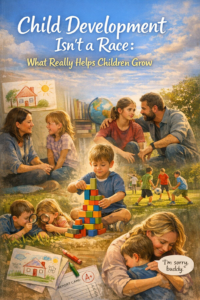
This doesn’t mean we never lose patience. It means we repair when we do. Repair is one of the most powerful tools in development. A simple “I’m sorry I raised my voice” teaches accountability better than a lecture ever could.
Every Child Has a Unique Timeline
One of the hardest things for parents today is comparison. Social media makes it worse. It feels like every child is reading early, speaking confidently, winning medals.
But development is not a race. Some children bloom early. Others take their time and then surge ahead in unexpected ways.
I’ve seen quiet children grow into strong leaders. I’ve seen academically average students develop remarkable emotional intelligence that carries them further than grades ever could.
When we rush children to meet external standards, we risk disconnecting from who they actually are.
What Children Really Need
After all the research, theories, and frameworks, the core needs are surprisingly simple:
- Consistent love
- Clear boundaries
- Emotional validation
- Opportunities to explore
- Space to fail safely
Notice that none of these mention perfection.
Children thrive not because their parents do everything right, but because they feel secure enough to grow.
A Gentle Reminder for Parents
Child development is not a project to manage. It’s a relationship to nurture.
There will be phases that test you. Regression after progress. Big emotions out of nowhere. Sudden independence that feels like rejection.
Take a breath.
Often, what looks like misbehavior is growth in disguise. What feels like defiance is a child practicing autonomy. What seems like clinginess is a need for reassurance during change.
If you stay curious instead of reactive, you will see development unfolding right in front of you.
And here’s something I tell every parent I work with: You are developing too.
As your child grows, so do you. Your patience stretches. Your understanding deepens. Your triggers surface. Parenting is not just about raising a child — it’s about refining yourself alongside them.
So instead of asking, “Is my child developing correctly?” perhaps ask, “Am I creating an environment where development feels safe?”
That question changes everything.