Tag: Parenting

Multiple Intelligence Theory

The theory of multiple intelligences was developed in 1983 by Dr. Howard Gardner, professor of education at Harvard University. It suggests that the traditional notion of intelligence, based on I.Q. testing, is far too limited. Instead, Dr. Gardner proposes eight different intelligences to account for a broader range of human potential in children and adults. These intelligences are:

  • Linguistic intelligence (“word smart”)
  • Logical-mathematical intelligence (“number/reasoning smart”)
  • Spatial intelligence (“picture smart”)
  • Bodily-Kinesthetic intelligence (“body smart”)
  • Musical intelligence (“music smart”)
  • Interpersonal intelligence (“people smart”)
  • Intrapersonal intelligence (“self smart”)
  • Naturalist intelligence (“nature smart”)

Dr. Gardner says that our schools and culture focus most of their attention on linguistic and logical-mathematical intelligence. We esteem the highly articulate or logical people of our culture. However, Dr. Gardner says that we should also place equal attention on individuals who show gifts in the other intelligences: the artists, architects, musicians, naturalists, designers, dancers, therapists, entrepreneurs, and others who enrich the world in which we live. Unfortunately, many children who have these gifts don’t receive much reinforcement for them in school. Many of these kids, in fact, end up being labeled “learning disabled,” “ADD (attention deficit disorder,” or simply underachievers, when their unique ways of thinking and learning aren’t addressed by a heavily linguistic or logical-mathematical classroom. The theory of multiple intelligences proposes a major transformation in the way our schools are run. It suggests that teachers be trained to present their lessons in a wide variety of ways using music, cooperative learning, art activities, role play, multimedia, field trips, inner reflection, and much more. The good news is that the theory of multiple intelligences has grabbed the attention of many educators around the country, and hundreds of schools are currently using its philosophy to redesign the way it educates children. The bad news is that there are thousands of schools still out there that teach in the same old dull way, through dry lectures, and boring worksheets and textbooks. The challenge is to get this information out to many more teachers, school administrators, and others who work with child.

Help Yourself and Your Child Busting the Exam Stress !!!

Help Yourself and Your Child Busting the Exam Stress!!!

Parents easily get stressed when the exam time of the children draw closer. Exams can really be stressful for the entire family, but in reality, it needn’t be this way. It’s understandable that the child will experience stress and anxiety. If we as parents stress out, kids will stress out even more. Instead of putting additional pressure, there is a lot that parents can do motivate their kids for scoring well and prepare systematically for their exams.

Here are 10 practical and handy tips for the parents that will help them prepare their kids score well in the exams and reduce stress:-

  1. Know your child’s Exam time table – A very helpful way to help reducing yours and your child’s stress during their exams. Parents must know what exam the child has got next in order to help them prepare on time. It proves to be an extra element of support. You can simply add it to your calendar or pin a copy of the exam time table onto the notice board.
  2. Regular monitoring of their studies– Always take some time out to monitor your child’s progress. Sit with your child and design a schedule so that he or she has enough time for revision. Lending a helping hand in building a useful schedule for their days and weeks will help them efficiently utilizing their time. Don’t let them putting off all the preparation for the last days.
  3. Cut back on distractions– Any distractions, be it TV, gadgets, phones, gatherings, parties or even a disturbance from siblings must be avoided. It’s imperative to give your child the right atmosphere during exams to make him perform and score well. Try to allocate a comfortable room or a space in the home for your child to study in peace. 
  4. Do not compromise on child’s nutrition – Your Child health might get affected while dealing with exams pressure. An extra and special care is very much required keeping in mind the pressure child has on his mind. Adding fresh and seasonal fruits may do wonders for them. It helps them improving their concentration levels. 
  5. Enough sleep is fundamental – Be it school or exam, enough sleep is essential for a child to perform well. Teenagers have a habit of catching up on social media before bed which can cut the sleep time resulting in them being tired right before their exam. Prohibiting device in bedroom especially during exams or cutting off the internet is highly recommended. Installing parental control is also advisable during exam time.
  6. Help them to be active – Encourage them to take breaks between studies. As studying continuously will tire out the brain and affect the ability to retain knowledge. A power nap, stretching exercises, listening to music OR dancing can refresh and re-energize them.  Processed food, high caffeine or sugar intake can make kids anxious during exam days. Teenagers are recommended not to exceed 100 ml of caffeine a day.  Encourage them to take plenty of water.
  7. Never compare your child – Comparing your child with other kids, using negative words to demean them, or questioning their caliber on the basis of scores will just hurt the sentiments of the child. His true potential shouldn’t be measured with scores in the exams. Parents must remember that  exams are just one of the many challenges your child will face and it’s not the end of life. So, take it easy!
  8. Reward your child efforts- Rewarding your child is important to motivate them to put their best foot forward. Don’t bribe them with expensive gifts. A simple family outing or catching up with friends or cousins after the exam can help the child to take his pressure off.
  9. Identifying warning signs, if any – Its imperative to ensure your child’s mental well-being too. It’s natural to feel anxious during exams. But if there are signs of extreme anxiety, loss of appetite, anger issues or irritated mood, these could indicate that the child is not keeping well. Always keep a check, intervene and talk to them at the right time.
  10. Stay calm – Don’t build too much pressure on them. Stand in support of your child, believe in his abilities, help them preparing for the exams without overburdening them with your expectations.


So, stay calm! And if you can’t, fake it till you make it. Try to hold your stress inside and not to discuss with your child.

Hope these tips will help you and your child staying stress free in the days of examinations. These tips will not only help them coping with stress but will also form the right outlook for exams.

Author

Neetu J. Talwar

ESL Trainer and Parenting Coach from Deep

“Children are just result of your actions”

“Children are just result of your actions”

Parents expect their child to be faithful, disciplined (getup early),be polite, helpful, not to greed, exercise daily, sleep early, not to use cell phones, not to eat chocolates and ice creams, get 100% grades, study all the time. Likewise there are thousands of expectations that a child expects from their parents. Aren’t we as a parent over burdening our kids with our never ending expectations?

My question is for each and every parent, are we doing the same things which we expect from our kids to do?

I don’t think so, instead of guiding our kids, we as a parent need to be trained at first, so that we can guide our kids in very healthy and progressive manner. Many of you will contradict with my viewpoint.

Let us understand with one example of our childhood, have you ever came across with the situation at home, when your father were actually present at home and someone from our relative call on landline or came to our door step, and then we were asked to say NO to them, that no one is at home or father is not at home. Don’t we think we ourselves are guiding and teaching our children to speak lies, then how do we expect our kids to speak truth always?

Let’s understand with a story,

In 1930’s there was a lady whose son was eating Jaggery a lot, but her mother wanted his child to stop this habit, so that lady decided to go to his idol Mahatma Gandhi, and she walked many km to reach Mr. Gandhi in very hot summer and finally reached his Ashram, then she requested Mr. Gandhi to help her out so that her child stop eating Jaggery. After listening patiently Mr. Gandhi asked that lady to come back after 2 weeks, and after two weeks that lady came once again and then Mr. Gandhi asked that boy, you should stop eating Jaggery it is not good for health, boy nodded and promised that he will not be eating Jaggery anymore, Mother was so curious why Mr. Gandhi took 2 weeks to say just one line,

Mr. Gandhi smiled and said 2 week before I was also obsessed with eating Jaggery, in 2 weeks I have quit eating Jaggery, so I needed time to do this.

So from this story we all parents should learn whatever we are guiding to our kids, Are we doing the same thing, if no then try to follow yourself first. It seems very typical to do it initially, but it will definitely give you best results in longer period for sure. Children are just result of our action, whatever we are doing, If we will exercise there is more chance that our child will exercise, if getup early our child will get up early, if we speak truth our child will speak truth, if we are polite, our child will be polite, if we share things and daily experiences with our kids then our child will also do the same with us. These small changes can persuade our kids to do what we expect from them.

 “So our children are just result of our actions, so check your actions first, change your habits, change your daily routine, it will persuade your child to follow it, because your child will not do whatever you ask them to do, they will do whatever they see”.


Mohnish Gahnolia

Parenting Coach

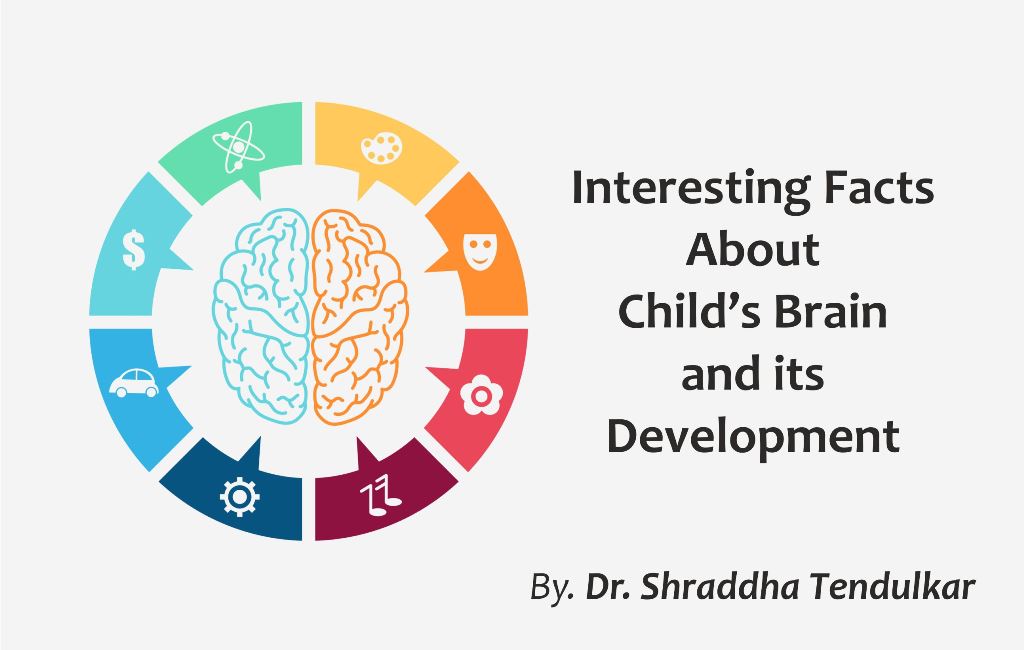
Interesting Facts About Child’s Brain and its Development

“Logic will get you from A to B. Imagination will take you everywhere.” ~ Albert Einstein

What is that Mr. Einstein has to do with brain, as we all know he was an all time genius and multitalented individual and one who gave so much to human kind in his lifetime. We find it quiet handful to have such people around. It is not that we have lesser number of geniuses and compassionate people born but we are not concerned about right training to our  kids at right time, they are all potential geniuses. We as parents are far more concerned about the hungry stomach and feed the best possible nutritious food but seldom concentrate on a child’s brain which is very very hungry of information since the birth.

Let us first understand the basics of brain development and further know how we can feed this hungry young brain.

The right brain connects us to our boundless sense of being. Being is primary; hence the right brain develops first till the age of 7 year’s. 80% of your brain develops by this age; hence, ‘human being’, not human doing. The left brain is far more interested in doing and develops and dominates the right side after 7 years of age till ones life time. Young right-brain dominant children, by contrast, are quite content being.

Knowing this here we come to know how important it is for a young child to play and learn in an unstructured way rather than under burden of academics and the rules we lay down on mugging up things and even worse grading them, labelling at this tender age with adult logic.

Pushing kids to literacy and numeracy before this age will create a batch of learned stupids who loose desire to learn and explore.

Let’s remember that life is less about what we excel and accomplish in this world. Rather, life is about being present and connecting with  love to all people and nature which children do so freely and naturally. This is the feature of right brain and  the left brain sunders life into pieces, the right brain unites. This is why babies and young kids sense no distinction between themselves and their environment.

More about right brain and how to effectively help our kids use it whilst it is active at its peak in my next article.

The intuitive mind is a sacred gift and the rational mind is a faithful servant. We have created a society that honors the servant and has forgotten the gift.” ~ Albert Einstein

Article by Dr Shraddha Tendulkar

source of information and Courtesy:Glenn Doman’s literature

How can we address kids Emotional Cravings?

How can we address kids Emotional Cravings?


Kids crave for parents undivided attention. Gizmos, gadgets, devices all are an escape route for them when they are not given to do things they truly want to engage themselves with. Have we ever realized just as we have cravings children too crave for a lot of things? Cravings are not only associated with eating disorders or providing for a sweet tooth, there are emotional cravings too. These days the pace of life is so fast that it is easy to shrug off our children’s emotional and psychological needs. How about listening to those cravings of your child and addressing them one step at a time? While it may not be possible to settle all their needs and cravings in one go but as parents can we hear them out by paying close attention to what they truly desire from a parent? All that children need is an emotional connection with their parents or primary caregivers.


Here are 10 things that kids crave to do with their parents.

1. Mamma  – Tell me story or read to me

2. Play hide and seek with me.

3. Involve me in your work. Can i help you mamma?

4. Can you get me a surprise today?

5. Can you take me to the garden today?

6. Let’s do a bubble bath together ?

7. Can you put nail paint on me.

8. Come with me, stay with me all the time.

9. When are we meeting my friends ? (Since lockdown this is one of the most frequently asked question by my girls.)

10. Don’t go to the office today. I want to play with you.


Well some ‘asks’ are easy and fun while the others may not be easy to address on an everyday basis and that is okay. What is important is, to understand that kids do not need expensive objects or toys, all they require is undivided attention, unstructured playtime and a non judgmental approach from their parents. So, what do your children crave from you? Do give it a thought. Hear them out. It’s time to get reflective and give them what they truly desire from you even if it is in piece-meal.


Let’s try to invest time in our children because these will help you build beautiful memories as a family. If we are able to give them the desired attention, that in itself is playing a big role in settling their cravings. So, what are you thinking? Get set going and be a family that has fun rather than the one that’s always on the run.


I hope you found this blog useful. Do share your ideas and suggestions on how you think kid’s cravings can be addressed.


Happy Parenting!

Aditi Malik

Blogger, Podcaster and Parenting Coach.

How to take care of your child’s mental health?

How to take care of your child’s mental health?

Living in the modern world, we all might have heard our peers’ discussing how emotional health is equally important as our physical health!

Well, it’s true. However, if you belong to Generation X or even if you are a Millennial, who is now a parent, you might relate to a lot of stuff discussed in this brief piece on mental health.

Remember the times when our hearts smiled more than our faces! Yes, I am referring to our childhood.

It was the time when innocence was the most prominent trait. Among our cousins and friends, there were occasional fights that lacked blame or ego.

A time when we used to play with toys that were not so electronic.

A time in life where the denial was mostly associated with “I won’t share my piece of cake or chocolate with anyone.”

A time so carefree… isn’t it?

While we grew up, every time somebody threw a No at us, most of us thought it’s such a blessing to grow up and live life on our terms. Little did we know of how much goes into living life on our own terms.

As we grew a little old and began experiencing the bits of life firsthand, we gradually enrolled ourselves for the rat race of making it big in life. Our spirits were then forced to carry the weight of performance and peer pressure.

Over time, these pressures and challenges lead to an understanding of the importance of emotional well being.

Would you like such a life for your child?

Definitely not! We all want our children to live a better life than ours and offer them the best possible support we can. Right?

Here, it’s crucial to note that just like physical health, emotional health is vital for the human body and soul.

Maintaining emotional wellbeing allows children and young adults to develop resilience to cope with whatever life throws at them and grow into well rounded, healthy adults.

Alarmingly, 70% of children and young adults experience a mental health problem such as depression, abuse, etc.

Most children grow up mentally healthy, but surveys suggest that many children and adolescents move towards depression and anxiety troubles. It has emerged to be a case because of the frequent changes in the way we live and how that affects a child’s experience growing up.

How can you maintain your Children’s mental health? 

1. Parental Help: Parents must have a warm, open relationship with their children. One essential job to be done is to pay full attention to your child and acknowledge their feelings. Reaching out and talking to them would help them avoid finding solace in harmful distractions like Smartphone’s, gaming, prohibited activities, etc.

2. Professional Help: A parental coach can assist and advise you to better understand your relationship with the child and provide you with the right tools to correct behavioural issues.

Let’s learn more about professional help.

Parent coaching sessions offer the progenitors with the tools required to handle nearly any situation in the family. The certified coaches are proficient in assisting moms and dads in creating a roadmap to:

● learn efficient ways to respond to scenarios instead of reacting abruptly

● imbibe ways to become patient and kind towards the child

● creating a calmer, happier, and more inviting environment for the child

● improve the overall relationship between parent and child

● learning effective ways to communicate with children of every age

● understanding the behavioural patterns and demands of children

We all are living in lifestyles that are busy and hectic. Reaching out for coaching helps solve prevalent issues and teaches parents the right way to deal with their child and avoid any arguing, whining, or bickering with them.

Each session provides techniques, tools, and strategies to handle specific family life issues. A coach avoids talking about the past and instead focuses all attention on now and the days ahead. With assistance, parents produce results by developing clear, concise steps to determine intentions, values, and goals for moving forward to a healthier family.

With every session, a parent can learn new techniques, strategies, or methods to handle specific family issues. A parent coach would always motivate you to focus on the future and avoid talking about the past. With the right assistance, you, as a parent, can witness fantastic results, leading to form a healthy and happy family.

While looking for your child’s mental health, below are some other aspects that can be worked upon are:

1) Maintaining good physical health, eating a balanced diet and following a regular exercise routine

2) Making them feel loved, trusted, understood, valued and safe

3) Making them learn and grab opportunities to succeed

4) Accepting who they are and recognizing what they are skilled at!

5) Since your child can test your nerves, attaining mindfulness will make you happier and let you manage anxiety, stress, and depression.


Author

Vishakha Goyal
Founder- LifeLitmus
IPA Expert, Parenting Coach, Access Bar Practitioner, Sound Healer

 

Help Yourself and Your Child Busting the Exam Stress!!!

Help Yourself and Your Child Busting the Exam Stress!!!

Parents easily get stressed when the exam time of the children draw closer. Exams can really be stressful for the entire family, but in reality, it needn’t be this way. It’s understandable that the child will experience stress and anxiety. If we as parents stress out, kids will stress out even more. Instead of putting additional pressure, there is a lot that parents can do motivate their kids for scoring well and prepare systematically for their exams.

Here are 10 practical and handy tips for the parents that will help them prepare their kids score well in the exams and reduce stress:-

  1. Know your child’s Exam time table – A very helpful way to help reducing yours and your child’s stress during their exams. Parents must know what exam the child has got next in order to help them prepare on time. It proves to be an extra element of support. You can simply add it to your calendar or pin a copy of the exam time table onto the notice board.
  2. Regular monitoring of their studies– Always take some time out to monitor your child’s progress. Sit with your child and design a schedule so that he or she has enough time for revision. Lending a helping hand in building a useful schedule for their days and weeks will help them efficiently utilizing their time. Don’t let them putting off all the preparation for the last days.
  3. Cut back on distractions– Any distractions, be it TV, gadgets, phones, gatherings, parties or even a disturbance from siblings must be avoided. It’s imperative to give your child the right atmosphere during exams to make him perform and score well. Try to allocate a comfortable room or a space in the home for your child to study in peace. 
  4. Do not compromise on child’s nutrition – Your Child health might get affected while dealing with exams pressure. An extra and special care is very much required keeping in mind the pressure child has on his mind. Adding fresh and seasonal fruits may do wonders for them. It helps them improving their concentration levels. 
  5. Enough sleep is fundamental – Be it school or exam, enough sleep is essential for a child to perform well. Teenagers have a habit of catching up on social media before bed which can cut the sleep time resulting in them being tired right before their exam. Prohibiting device in bedroom especially during exams or cutting off the internet is highly recommended. Installing parental control is also advisable during exam time.
  6. Help them to be active – Encourage them to take breaks between studies. As studying continuously will tire out the brain and affect the ability to retain knowledge. A power nap, stretching exercises, listening to music OR dancing can refresh and re-energize them.  Processed food, high caffeine or sugar intake can make kids anxious during exam days. Teenagers are recommended not to exceed 100 ml of caffeine a day.  Encourage them to take plenty of water.
  7. Never compare your child – Comparing your child with other kids, using negative words to demean them, or questioning their caliber on the basis of scores will just hurt the sentiments of the child. His true potential shouldn’t be measured with scores in the exams. Parents must remember that  exams are just one of the many challenges your child will face and it’s not the end of life. So, take it easy!
  8. Reward your child efforts- Rewarding your child is important to motivate them to put their best foot forward. Don’t bribe them with expensive gifts. A simple family outing or catching up with friends or cousins after the exam can help the child to take his pressure off.
  9. Identifying warning signs, if any – Its imperative to ensure your child’s mental well-being too. It’s natural to feel anxious during exams. But if there are signs of extreme anxiety, loss of appetite, anger issues or irritated mood, these could indicate that the child is not keeping well. Always keep a check, intervene and talk to them at the right time.
  10. Stay calm – Don’t build too much pressure on them. Stand in support of your child, believe in his abilities, help them preparing for the exams without overburdening them with your expectations.

So, stay calm! And if you can’t, fake it till you make it. Try to hold your stress inside and not to discuss with your child.

Hope these tips will help you and your child staying stress free in the days of examinations. These tips will not only help them coping with stress but will also form the right outlook for exams.


Author

Neetu J. Talwar

ESL Trainer and Parenting Coach from Deep


Parenting Lessons from the Vienna General Hospital

Parenting Lessons from the Vienna General Hospital


The Vienna general hospital had two maternity wards, one handled by doctors and the other by midwives. In the mid-1800s, Dr. Ignaz Semmelweiz was heading the ward that was being handled by doctors. The surprising fact was that the mortality rate of mothers who were looked after by the doctors was 1 in 10 and the mortality rate of mothers looked after by midwives was 1 in 50. This was quite embarrassing for the doctors. They tried changing the bedsheets, cleaning the floors window curtains, but the mortality rate remained the same. They even laid down SOPs for both the wards so that there was uniformity in all respects. Even after all these measures, there was no change in the mortality rates.

The situation was so alarming that many women preferred to deliver on the streets than go to the ward looked after by the doctors for the fear of dying. Dr. Ignaz happened to visit another hospital and was away from Vienna general Hospital for few months and in these few months, the mortality rates of the women at the ward looked after by doctors also reduced to 1 in 50.

Dr. Ignaz after returning from his visit began to examine the reason for this and he found out that, since they were in a  research institute most of the doctors split their time between research on cadavers and treatment of live patients. After doing research, dissecting a cadaver they went on to treat live patients. The very doctors who were supposed to treat the patients were unknowingly carrying the germs that caused the patients to die. They had no idea of germs at that time. Dr. Ignaz found out that he spent far more time on research on cadavers and then directly attended to the pregnancies.

It was Dr. Ignaz after his discovery that he formulated the germ theory. It was after this discovery that all doctors were advised to wash their hands with chlorine and lime. It was a simple solution, but it solved a grave problem. The mortality of women treated by doctors dropped drastically to 1 in 100 after they started washing their hands with chlorine and lime.


What can we learn from this incident?

Just like the doctors were unknowingly responsible for the deaths of their patients, many times parents are unknowingly responsible for crushing the child’s dreams and making him/her follow dictates that they feel is right

It needs unconditional love to view children as completely different human beings with curiosity to experiment and discover life on their own.

Parents need to master active listening to understand the unsaid words, the unspoken language and not force a child to just listen to what they say and expect the child to follow without complaining.

It is understandable that all parents do what they do with the intention of giving the best to their children. However, just like the doctors of the Vienna general hospital, they unknowingly do more harm than good.

The focus needs to move from the external world to the inner world, then the entire approach will undergo a dramatic change. The solution may be very simple like washing the hands of the doctors, but the impact can be profound.

Parents need to step back just like Dr. Ignaz who went on a visit to another hospital, which prompted him to search for significant differences in approaches in the doctor’s ward and the midwife’s ward.

The changes could be as simple as choosing a different set of words that we use or just listening to the child without judgement or maybe expressing how you feel or just allowing him/her to take responsibility.


Yes! Everything starts with awareness of the situation and taking the appropriate action.

Girish Paniker

Parent Alchemist


BRACHIATION – A SIMPLE PLAY WITH MULTIPLE BENEFITS  

BRACHIATION – A SIMPLE PLAY WITH MULTIPLE BENEFITS

Do you remember when did you last brachiate or have motivated your child to do so? Well now what is this new term Brachiation, it is nothing but simply hanging and monkeying around on trees or on the metal ladders which we have in our park’s or playgrounds.

We hardly pay heed to such simple and interesting activities nor do we dig deep to know the science hidden behind it, have we ever given a piece of mind onto why such ladders were there on playground? And usual answer we get is to increase your height.

There are many benefits of brachiation apart from increasing the height. Brachiation is the ability to swing from rung to rung on an overhead ladder. It is considered one of the milestone like crawling, scooting, walking.

This activity is extremely easy for a very young child and extremely difficult for an adult.

10 most important benefits of the brachiation ladders:

  • Improvement of intelligence.
  • Extension of the rib cage. Greater thoracic extension means more oxygen for the brain.
  • Improvement of breathing
  • Increase in the strength of the hands and arms.
  • Help in the proper development of the back.
  • Decrease in respiratory diseases.
  • Better definition of the laterality of the brain.
  • Better development of manual skill.
  • Greater ease and dexterity when writing.
  • Improvement of visual convergence.
  • Optimal development of eye-hand coordination.

From the sensorial point of view, the brachiation ladder must be made of wood and never of iron, aluminum or plastic. Also with the wood, the hands do not slip.

Try to have one brachiation ladder at home instead of expensive mindless toys. Children will have an activity which could be one substitute to reduce screen time as well.

Happy Parenting and Happy Brachiating

Article by Dr Shraddha Tendulkar

Source of information and Courtesy: Glenn Doman’s book

15 Affirmations for Moms to Help Reduce Anxiety and Increase Positivity

15 Affirmations for Moms to Help Reduce Anxiety and Increase Positivity


It’s often been said that motherhood is the most difficult job in the world. Indeed, there is no task more challenging than caring for the emotional, physical, and mental health of another human being. As a mom it is so easy to feel overwhelmed, overworked and stressed.


If you tell yourself negative things daily – guess what, you are setting yourself up for failure or repeat patterns of life. I believe in the power of affirmations so much because What we believe about ourselves at a subconscious level has a significant impact on the outcome of events. This is because the mind doesn’t know the difference between what is real or fantasy. Amazing right?


Pick any two of these affirmations daily and use them for at least 21 days!. Save them, say them whenever you can, or write them down every morning. Post them where you will see them. Come back here and comment below to let me know what miracles you see changing


  1.  I respect my children; I respect myself.
  2.  I am a blessing to my children. I am a powerhouse
  3.  I am doing an amazing job. I wake up today with strength in my heart and clarity in my mind.
  4.  I am my child’s lifelong teacher.
  5.  I can trust my maternal intuition.
  6.  I am learning to be a better mother with each new day.
  7.  I will take care of myself in order to be a good mother.
  8.  I am doing the best that I can for my children and it is enough.
  9.  I am becoming a more confident mother with each new day. I am at peace with all that has happened, is happening, and will happen.
  10.  My marriage is becoming stronger, deeper, and more stable each day
  11.  I am creating positive, lifelong memories with my children.
  12.  I know better than anyone else what my children need.
  13.  I am allowed to ask for help as a mother. I deserve time to relax.
  14.  Today I will see the best in my child and the best in myself.
  15.  The decisions made by other moms do not need to dictate mine.


Which of these mama-mantras stands out to you today?


Regards

Swati Mahajan

Parenting Coach