Sweet 42.
I am deeply grateful to my parents. They did their best, just as most parents do, with the love, understanding and resources they had.

They gave me so much.
And yet, somewhere inside me, there was a little boy who needed more appreciation, emotional support, reassurance and care.
Both things can be true.
You can be grateful for your parents and still acknowledge what your younger self needed.
For years, I wanted love.
Validation.
Approval.
Guidance from people I trusted.
I kept myself busy. Working. Achieving. Performing. Helping others. Trying to become better.
From the outside, it might have looked like ambition.
But deep inside, I now wonder…
Was I trying to achieve something, or was I trying to earn a feeling?
The feeling of being enough.
Of being appreciated.
Of being seen.
Of being loved, without having to do anything extraordinary to deserve it.
Perhaps you know that feeling, too.
Perhaps you were the child who scored well, behaved well, made everyone proud or learned to hide tears behind a smile.
Perhaps you became the dependable adult who takes care of everyone but quietly wishes someone would ask, “And how are YOU doing?”
If this touches something inside you, pause for a moment.
You are not weak for having needed love.
You were a child.
And children need more than food, education, clothes and opportunities. They need to feel emotionally safe, valued, understood and accepted.
Our parents may have given us everything they knew how to give. Yet some of our emotional needs may have remained unnamed, even to ourselves.
For a long time, I didn’t know how to name mine.
And because I couldn’t name them, I couldn’t consciously learn to meet them.
I kept looking outside for something I had never learned to offer myself.
The Brain Coach’s Discovery
Through years of exploring brain patterns, human behaviour and innate strengths, I began noticing something fascinating.
Some people seem naturally comfortable taking risks, expressing themselves, receiving appreciation and trusting their abilities.
Others struggle with self-doubt, fear of rejection and the need for approval.
Our inborn temperament, experiences, relationships and environment can all influence how we respond to life. But our starting point doesn’t have to be our finishing point.
What comes naturally to one person can become a skill that another person learns.
Self-awareness can be learned.
Emotional vocabulary can be developed.
Self-compassion can be practised.
Confidence can grow.
And healthier ways of relating to ourselves and others can be nurtured.
That realisation changed something in me.
Brain decoding was never just about understanding someone’s strengths.
It was about understanding the human being behind those strengths.
And yesterday, something became even clearer.
I discovered my WHY.
I don’t want children to grow up believing they must hide their feelings, suppress their needs, perform perfectly or keep winning approval just to feel worthy of love.
I don’t want mothers to spend years wondering why their children behave differently from one another, why one needs encouragement while another needs space, or why the same parenting approach works for one child but not the other.
I want us to become curious about the little human being in front of us.
Not just, “How can I make my child behave?”
But, “What might my child be feeling, needing or trying to communicate?”
Because sometimes, behind the anger is frustration.
Behind the silence is a need for safety.
Behind the constant achievement is a fear of disappointing someone.
And behind the words “I’m fine” may be a child who doesn’t yet know how to say, “Please understand me.”
Of course, no single behaviour tells us exactly what a child feels. We have to listen, observe and ask with love.
Self-Love Is the Noodles. Love From Others Is the Sauce.
Years ago, I created a video using this metaphor.
Imagine sitting down to eat a delicious plate of noodles.
The noodles are your relationship with yourself.
The sauce is the love, appreciation and approval you receive from others.
The sauce makes the meal richer. It adds flavour, joy and connection.
We all need love from other people. Human beings thrive through caring relationships.
But what happens when you have only sauce and no noodles?
You may keep looking for another spoonful, another compliment, another achievement, another person to tell you that you matter.
And still, something feels missing.
Because the sauce was never meant to be the entire meal.
Cook your own noodles, my friend. ❤️
Learn to appreciate yourself.
Listen to your emotions.
Respect your needs.
Celebrate your progress.
Speak to yourself with kindness.
Let other people’s love be the beautiful sauce that adds flavour to a life you are already learning to nourish.
And here’s my honest confession.
I could explain this metaphor intellectually long before I could fully live it.
Talking about self-love was easier than practising it on the days I felt unseen, unappreciated or uncertain.
Knowing the lesson and embodying it are two different journeys.
I am still learning.
And, for the first time, I am learning to enjoy the journey instead of treating myself like another project that needs fixing.
Perhaps healing begins when we stop asking, “What’s wrong with me?” and gently begin asking, “What have I needed, and how can I care for myself now?”
The Little Acronym I Wish Every Parent Knew: S.E.E.N.
If you care for a child between 0 and 12, here is a simple reminder.
S — Stop and notice.
Look beyond the behaviour. What might your child be experiencing?
E — Explore their emotions.
Ask, “Are you feeling disappointed, worried, excited or something else?”
E — Encourage their uniqueness.
Notice their interests, natural strengths, pace and individual way of approaching the world.
N — Nurture without comparison.
Help them grow without making them feel they must become someone else to deserve your approval.
You don’t have to be a perfect parent.
You don’t need to get every conversation right.
Sometimes, the most powerful words are these:
“I may not understand yet, but I want to.”
“Tell me more.”
“You don’t have to win to make me proud.”
“I love you when you succeed, and I love you when you struggle.”
Imagine hearing those words as a child.
Imagine what they might have meant to you on the day you came home with disappointing marks, lost a competition, made a mistake or simply couldn’t explain why you were crying.
Perhaps you would have cried a little less.
Perhaps you would have smiled a little sooner.
Perhaps you would have felt safe enough to be yourself.
And perhaps, as an adult, you are now learning to offer yourself some of that same kindness.
It’s not too late.
You can honour your childhood without remaining trapped in it. You can be grateful for your parents while acknowledging your pain. You can love your family and still learn new ways of loving yourself.
That is not betrayal.
That is growth.
As psychologist Carl Rogers wrote, “The curious paradox is that when I accept myself just as I am, then I can change.”
My Dream for Every Mother and Child
I dream of a world where children don’t have to become toppers to feel valued.
Where quiet children aren’t mistaken for weak children.
Where sensitive children aren’t told to stop feeling.
Where energetic children aren’t defined only by their restlessness.
Where children can discover their strengths without being compared to their siblings, classmates or neighbours.
Where mothers understand that their child isn’t a problem to be solved, but a person to be understood.
And where mothers also receive the same compassion they so freely give their children.
Because this is a win-win.
When we understand our children’s individual nature, we can respond with greater awareness instead of reacting from frustration.
When we understand ourselves, we can begin to recognise which reactions come from the present moment and which may be connected to our own unmet needs.
And when we learn to pause, listen and respond with care, we give the next generation an opportunity to grow with greater self-awareness, emotional intelligence and confidence.
This doesn’t guarantee a perfect childhood or a life without struggles.
It offers something beautiful: a better starting point.
A child who learns that emotions can be named, mistakes can be discussed, strengths can be nurtured and love doesn’t have to be earned through constant performance.
That is the kind of leadership I want us to nurture.
Not leadership that needs to prove its worth every day.
But leadership that grows from knowing who you are, respecting others and having the courage to contribute your gifts.
At 42, I am learning to give myself some of what I spent years seeking from the world.
And I am grateful.
Grateful for my parents.
Grateful for my experiences.
Grateful for the work that helped me understand people.
Grateful for the little boy I once was, who kept trying so hard.
He wasn’t broken.
He was learning.
And perhaps, in some ways, so are we all.
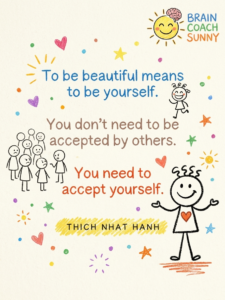
If you are a mother of a child aged 0–12, or you know someone who is, please share this message.
Let’s help more families discover the beauty of understanding a child’s innate nature, nurturing their individual strengths and creating homes where children feel seen, heard, loved, valued, appreciated and understood.
Because the earlier we begin, the more opportunities we create for children to develop healthy ways of understanding themselves and relating to the world.
And if you are an adult still learning to love yourself, this message is for you, too.
You deserve kindness today, not only after your next achievement.
Sending smiles. 😊
Sending love.
And a little extra appreciation for the child you once were.
One question to sit with today:
If the little child you once were could sit beside you right now, what would they most need to hear from you — and what is one thing you could do today to help them feel loved?
I’d love to hear your reflections in the comments.
With gratitude,
Brain Coach Sunny
#Gratitude #EmotionalIntelligence #SelfAwareness #Leadership #SelfEsteem #GrowthMindset