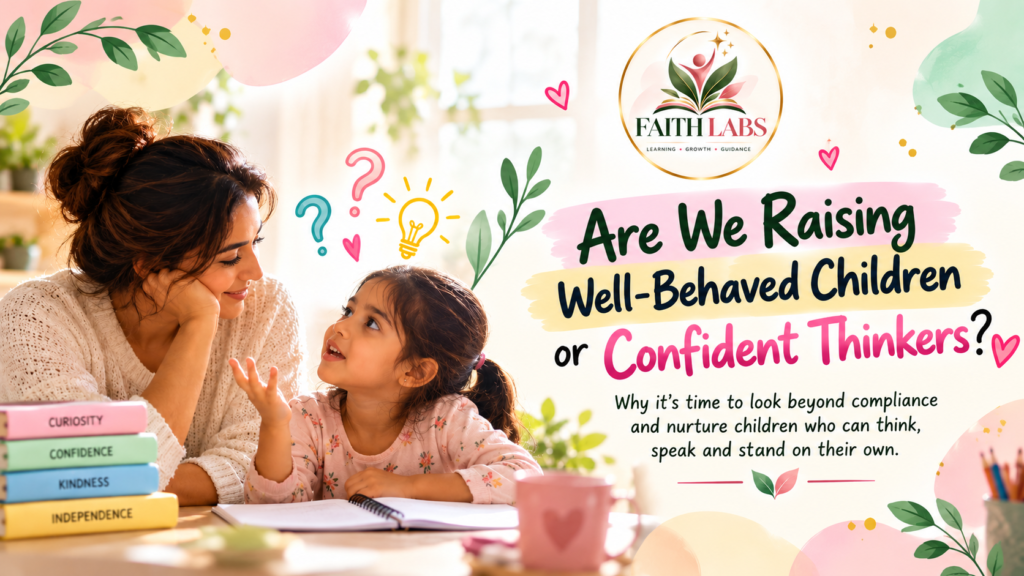
Children need space to question, choose, make mistakes and find their voice.
We often celebrate the child who sits quietly, follows instructions, never argues and always says, “Okay.” Some say, “What a well-behaved child!”
There is value in teaching children respect, boundaries, responsibility and consideration for others. But somewhere along the way, perhaps we need to pause and ask ourselves: Are we raising children who simply know how to behave or children who know how to think, speak and stand on their own?
Confidence doesn’t always look like compliance. A confident child may ask, “Why?” They may say, “I don’t agree.” They may suggest, “Can I try it another way?” They may admit, “I made a mistake.” They may even tell us, “I don’t feel comfortable with this.” These responses can sometimes feel challenging to adults. We may interpret questioning as disrespect, disagreement as defiance, or independence as stubbornness.
But what if some of these moments are actually opportunities for growth?
The difference between obedience and confidence
Obedience teaches a child to follow expectations. Confidence helps a child understand why those expectations exist and eventually develop the ability to make thoughtful choices independently. We certainly don’t want children growing up believing that every rule is optional. Children need boundaries. They need consistency. They need adults who provide guidance and structure. But they also need opportunities to develop their own voice.
If a child is constantly taught, “Don’t question me,” “Just do what you’re told,” or “Because I said so,” they may become very good at following directions.
But will they know what to do when an adult isn’t there to give them the answer?
Will they be able to recognise an unhealthy situation?
Will they speak up when something doesn’t feel right?
Will they make decisions when there isn’t a clear instruction to follow?
These are the skills that matter far beyond childhood.
Confidence needs room to practise
We cannot simply tell children to “be confident” and expect confidence to appear. Confidence develops through experience. It grows when children are allowed to make age-appropriate choices. It grows when their opinions are heard—even when the final decision belongs to the adult. It grows when mistakes are treated as opportunities to learn rather than reasons for shame. It grows when a child discovers: “My voice matters.” This doesn’t mean giving children complete freedom. It means creating safe spaces where they can practise independence within appropriate boundaries.
Instead of always saying, “Do this,” we might sometimes ask: “What do you think we should do?”
Instead of immediately correcting: “What made you choose that?”
Instead of solving every problem: “What could you try next?”
Small questions can create big shifts.
So, who are we really raising?
Perhaps the goal isn’t to raise children who never question us. Perhaps it is to raise children who know how to question thoughtfully. Not children who never disagree, but children who can disagree respectfully. Not children who never make mistakes, but children who can recover from them. Not children who simply follow instructions, but children who can eventually make wise decisions when we aren’t there to give the instructions. A well-behaved child may make our lives easier today. But a confident, thoughtful and responsible child is better prepared for the world they will inherit tomorrow.
So the next time your child asks “Why?”- Don’t see it only as a challenge rather see it as a little mind learning how to think.
🌱 Faith in every child. Faith in every possibility. ❤️
– Faith Labs