“Sometimes ‘I’m fine’ is not a request to be left alone. It is a test of whether anyone will stay.”
Aarav (a composite, details changed) was never a “problem child.”He submitted his work, smiled in the corridor and told his mother “I’m fine” every evening. Over one term, his friends shrank from five to one. He stopped playing cricket at lunch. His marks slipped, then slipped again. His mother told herself it was Class 10 pressure and that he would talk when he was ready.
He didn’t. By the time a teacher spoke up, he had been struggling for months.
If you missed the signs, it is not a failure of love. These signs look like normal growing up.
What the research tells us
WHO estimates that about one in seven adolescents aged 10 to 19 lives with a mental health condition, and most go untreated. In India the silence runs deeper. Only 41 per cent of Indian young people aged 15 to 24 said it is good to seek support for mental health problems, against an average of 83 per cent across 21 countries. Around one in seven in this age group often felt depressed or had little interest in doing things. Many young Indians are struggling, and many believe they should struggle alone. (unicef) (morungexpress)
Connection protects. Large studies show that feeling close to a parent or school adult is among the strongest buffers against distress. That adult doesn’t have to be perfect, only reachable.
What we are ignoring
Distress looks like coping. Many teenagers keep their marks and attendance while falling apart privately.
“Fine” is a learned answer. If “I’m not okay” has been met with a lecture, “fine” becomes the safest reply.
Marks have become our main language. When grades are the first question every day, teenagers learn that performance is what we value, and shame keeps them silent.
Contact isn’t closeness. A teenager can be in group chats all day and still have no one to call at midnight.
Privacy or warning sign?
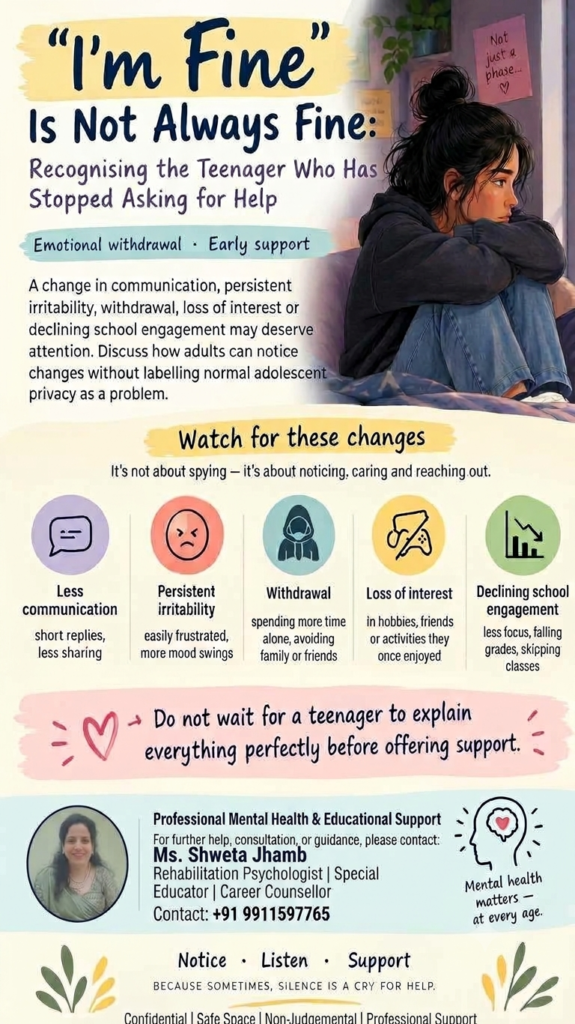
Teenagers need privacy, and a closed door is not a crisis. Ask instead: Is this different from how they usually are, and has it lasted? Gently take notice when several of these appear together for two weeks or more:
Shorter answers, or no longer sharing small things
Ongoing irritability or flatness
Dropping friends or activities they loved
Changes in sleep or appetite
Falling school engagement, or aches on school mornings
Remarks like “what’s the point”
What helps
Offer support before you understand. “You seem different lately. You don’t have to explain. I’m here.”
Talk side by side. Car rides and walks feel safer than sit-down talks.
Be specific and soft. “I miss hearing about your day” opens more than “Are you okay?”
Listen before fixing. “That sounds really heavy” keeps the door open. “It’s nothing, don’t worry” closes it.
Ask about safety directly if worried. Asking about suicide does not plant the idea. Stay calm, stay close, and involve a professional quickly.
Keep offering, in small ways. One big talk rarely works. Repeated small invitations tell them the door is still open.
Bring in a second adult. A counsellor, teacher or relative may be easier to talk to. That is a safety net working, not rejection.
Back to Aarav
His class teacher said, “You seem quieter than before, and I’d like to know you’re okay.” He shrugged: “I’m fine.” She said, “Okay. The offer stays open.” A week later, he stayed back after class. Weeks after that, he could name what he was feeling. He later said the open offer was why he came back.
Don’t wait for a teenager to explain everything perfectly before offering support. Sometimes “I’m fine” is not a request to be left alone. It is a test of whether anyone will stay.


 ens next.


 As parents, we often find ourselves reminding our children what not to do. But how often do we pause to notice what they are doing right?