Olympus Blog

In the Olympus blog you'll find the latest news about the community, tutorials, helpful resources and much more! React to the news with the emotion stickers and have fun!
Bottom image

Growth is Not Perfection

Growth Is Not Perfection

Growth does not mean becoming perfect. Perfection is an impossible destination. Growth is movement.

You will make mistakes. You will have difficult days. You will sometimes lose your patience. You will sometimes choose badly. You will sometimes return to an old habit you thought you had overcome. None of this automatically means you have failed.

The question is not:

“Did I make a mistake?”

The better question is:

“What will I do next?”

A mistake can become a dead end, or it can become a lesson. A setback can become an excuse, or it can become an opportunity to develop resilience. A difficult season can make us bitter, or it can deepen our understanding of ourselves and others. Growth does not remove difficulty from life.

It changes our capacity to meet difficulty.

The Gift of Patience

The Gift of Patience

Parenting in a world of instant gratification

Groceries in 10 minutes. Movies and shows on demand. Answers at the click of a button. Everything is available at our fingertips, often through a single cellphone. Childhood today is growing up in a world where convenience is everywhere.

While this ease of anything and everything has made life comfortable, it has quietly stolen something very precious: the opportunity for our children to practice patience.

“Patience is golden” It is not only the ability to wait, but the strength to manage frustration, to persist when things take effort, not to give in or give up in the face of a setback, and most importantly, to accept that not every wish will be fulfilled immediately, or sometimes at all.

Psychologists call this the balance between delayed gratification (waiting for a bigger reward later) and denied gratification (understanding that some desires may never be met). Together, these lessons build resilience, discipline and emotional maturity, which enable long-term success.

So how can parents raise a child with this priceless gift, in a world that celebrates instant gratification?

Modelling patience in daily life

Children learn more from what we do than from what we say. When we honk away at a red light, tap the steering wheel impatiently or complain while waiting, it reflects to the child that waiting is frustrating and unacceptable. But by staying calm, we can teach our children that waiting is not only natural, but manageable.

Think about the next time you are stuck at a red light. Instead of showing your impatience, take a breath and wait calmly. Our everyday actions often teach more than a lecture ever could.

Create small waiting opportunities

Practise patience in small, manageable moments. Start with short waits and gradually increase the time. So, the next time your child comes asking for a cookie, tell them, “Yes, you can have one. Let me finish the work at hand first.”

A few minutes may seem like an eternity to a child. But once they succeed, they begin to realise that waiting is possible. Keep the wait reasonable, and remember to follow through when you said you would.

Praise waiting efforts

“As sunlight is to a plant, so is recognition to a child. They thrive on recognition.” When you notice your child waiting patiently, appreciate it. You could say, “I really appreciate how calmly you waited while I finished my work.”

Recognising the effort reinforces the behaviour. Persistent positive attention and appreciation can ease the frustration that comes with waiting. Be specific about what your child did well, so they know what you are appreciating.

Teach the power of ‘NO’

It can be tempting to give in to every request when a child throws a tantrum. But learning to accept ‘NO’ is crucial for building a calm and confident child. If your child wants more cookies despite having had their share, instead of giving in, calmly explain: “Not today. You’ve had your share for the day.”

At first, the child may resist. But over time, they can begin to understand that every wish cannot be fulfilled, and that it is okay to feel disappointed. We can acknowledge the feeling without changing the boundary.

Break big tasks into smaller ones

When a big task overwhelms your child, help break it into smaller, manageable challenges. Completing each part teaches persistence and the value of steady progress, rather than leaving the child feeling impatient or overwhelmed.

Whether it is finishing homework, learning a new skill or tidying a room, focus on the next small step. Celebrate the effort and progress, not just the final result.

Patience through the ages

While young children live in the moment, patience can be taught playfully. A teenager may crave independence, but goals such as academic success, sports and college dreams require long-term effort.

For a preschooler, games like Simon Says or pauses during story-telling can make waiting fun. A school-age child can be taught to break tasks into steps and practice persistence rather than rushing to finish. A teenager can be encouraged to work steadily towards a goal, understanding that progress takes time.

Each stage offers parents an opportunity to guide children gently towards the understanding that not everything worthwhile comes instantly.

Patience is not taught in a single lesson. It grows in small moments: waiting together, breathing together, and persisting together.

Whether your child is three or thirteen, every moment of calm guidance plants seeds that can grow into a lifelong gift.

Raising Children. Building Character. Creating Legends.

Why Children Stop Sharing Their Feelings with Their Parents

Why Children Stop Sharing Their Feelings with Their Parents

Sometimes, children don’t stop talking because they have nothing to say. They stop because they are afraid of how we might respond.

Have you ever asked your child, “How was your day?” only to receive a one-word answer: “Fine”?

Have you noticed your teenager sharing more with friends than with you? Or your younger child becoming unusually quiet after making a mistake?

As parents, we may assume that our children are becoming secretive, stubborn, or distant. But sometimes, there is a deeper reason: they may not feel emotionally safe enough to share what is truly happening in their hearts.

1. When Correction Comes Before Connection

Imagine a teenager named Aarav who comes home with disappointing marks. He gathers the courage to tell his mother, hoping she will listen.

Instead, she immediately responds, “I told you not to waste time on your phone! Why can’t you be more responsible?”

Aarav becomes silent.

His mother believes she is correcting his behaviour and teaching him responsibility. But Aarav may walk away feeling misunderstood rather than supported.

When children expect criticism, comparison, or a lecture every time they share a problem, they may gradually learn to keep their struggles to themselves.

Before correcting a child, connect with the child.

2. Children Need to Be Heard, Not Immediately Fixed

When children share their worries, parents naturally want to offer solutions. We want to protect them from pain and help them make better decisions.

But sometimes, children don’t need an immediate solution. They need someone who will listen without judging them.

Instead of saying, “That’s not a big problem,” try saying:

“I can see that this is upsetting you. Would you like to tell me more?”

Instead of immediately giving advice, ask, “Would you like me to listen, or shall we think of a solution together?”

These small changes communicate an important message: Your feelings matter to me.

3. Avoid Comparing Their Struggles

Statements like “Look at your cousin,” “Your friend can do it,” or “When I was your age, I never behaved like this” may seem motivating to adults.

However, repeated comparisons can make children feel inadequate or ashamed.

Every child has a different temperament, learning pace, personality, and emotional experience. Children need guidance and boundaries, but they also need to know that their worth is not measured against someone else’s achievements.

Celebrate their efforts, acknowledge their progress, and help them learn from mistakes without making them feel that they are a disappointment.

4. Create Small Moments of Emotional Safety

Building trust doesn’t always require long conversations or special outings. Often, it begins with a few undistracted minutes every day.

Try these simple practices:

  • Put your phone aside when your child wants to talk.
  • Ask open-ended questions such as, “What was the hardest part of your day?”
  • Listen without interrupting or rushing to judge.
  • Acknowledge their feelings, even when you disagree with their choices.
  • Keep your promises and apologise when your own reaction is unfair.

Most importantly, respond calmly when your child tells you something difficult. You can still set firm boundaries while treating their feelings with respect.

Remember, emotional safety does not mean allowing every behaviour. It means making sure children can speak honestly without fearing humiliation or rejection.

5. Rebuild the Connection, One Conversation at a Time

If your child has already stopped sharing, don’t demand that they open up immediately. Trust cannot be forced; it grows through consistent experiences of being heard and respected.

You might begin with a simple sentence:

“I realise that sometimes I correct you before I fully understand you. I’m sorry. I want to listen better, and I’m willing to work on that.”

Your child may not respond immediately. That’s okay. Let your actions reinforce your words.

Over time, patient listening and respectful communication can help create a relationship in which children feel more comfortable seeking support when life becomes difficult.

A Final Thought for Every Parent

Our children may forget many of the instructions we give them, but the way we make them feel when they are vulnerable can leave a lasting impression.

The goal is not to become a perfect parent. It is to become a parent who is willing to listen, learn, apologise, and grow alongside their child.

Before asking, “Why doesn’t my child tell me anything?” let us gently ask ourselves, “What does my child experience when they tell me something?”

Because sometimes, the first step towards raising a confident child is not teaching them to speak up. It is showing them that their voice is safe with us.

With awareness and empathy, let’s raise emotionally secure children.

S. Nilofer Rahi
Parent Empowerment Mentor | Founder, Amazing Parenting Consultancy
Amazing Parenting — Connection Before Correction.

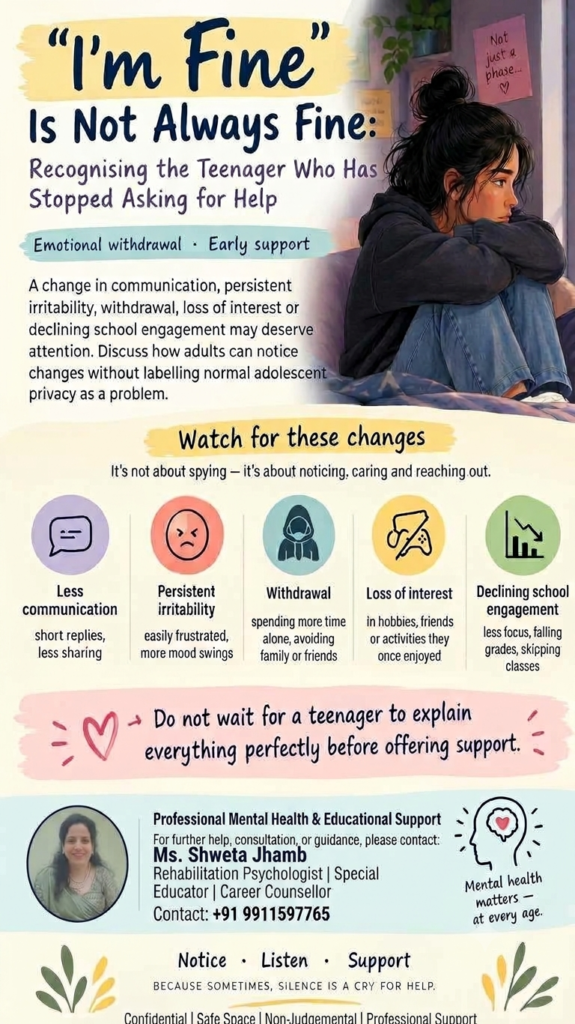
“I’m Fine” Is Not Always Fine: The Teenager Who Has Stopped Asking for Help

“Sometimes ‘I’m fine’ is not a request to be left alone. It is a test of whether anyone will stay.”

Aarav (a composite, details changed) was never a “problem child.”He submitted his work, smiled in the corridor and told his mother “I’m fine” every evening. Over one term, his friends shrank from five to one. He stopped playing cricket at lunch. His marks slipped, then slipped again. His mother told herself it was Class 10 pressure and that he would talk when he was ready.
He didn’t. By the time a teacher spoke up, he had been struggling for months.
If you missed the signs, it is not a failure of love. These signs look like normal growing up.
What the research tells us

WHO estimates that about one in seven adolescents aged 10 to 19 lives with a mental health condition, and most go untreated. In India the silence runs deeper. Only 41 per cent of Indian young people aged 15 to 24 said it is good to seek support for mental health problems, against an average of 83 per cent across 21 countries. Around one in seven in this age group often felt depressed or had little interest in doing things. Many young Indians are struggling, and many believe they should struggle alone. (unicef) (morungexpress)
Connection protects. Large studies show that feeling close to a parent or school adult is among the strongest buffers against distress. That adult doesn’t have to be perfect, only reachable.

What we are ignoring
Distress looks like coping. Many teenagers keep their marks and attendance while falling apart privately.
“Fine” is a learned answer. If “I’m not okay” has been met with a lecture, “fine” becomes the safest reply.
Marks have become our main language. When grades are the first question every day, teenagers learn that performance is what we value, and shame keeps them silent.
Contact isn’t closeness. A teenager can be in group chats all day and still have no one to call at midnight.

Privacy or warning sign?
Teenagers need privacy, and a closed door is not a crisis. Ask instead: Is this different from how they usually are, and has it lasted? Gently take notice when several of these appear together for two weeks or more:
Shorter answers, or no longer sharing small things
Ongoing irritability or flatness
Dropping friends or activities they loved
Changes in sleep or appetite
Falling school engagement, or aches on school mornings
Remarks like “what’s the point”

What helps

Offer support before you understand. “You seem different lately. You don’t have to explain. I’m here.”
Talk side by side. Car rides and walks feel safer than sit-down talks.
Be specific and soft. “I miss hearing about your day” opens more than “Are you okay?”
Listen before fixing. “That sounds really heavy” keeps the door open. “It’s nothing, don’t worry” closes it.
Ask about safety directly if worried. Asking about suicide does not plant the idea. Stay calm, stay close, and involve a professional quickly.
Keep offering, in small ways. One big talk rarely works. Repeated small invitations tell them the door is still open.
Bring in a second adult. A counsellor, teacher or relative may be easier to talk to. That is a safety net working, not rejection.

Back to Aarav
His class teacher said, “You seem quieter than before, and I’d like to know you’re okay.” He shrugged: “I’m fine.” She said, “Okay. The offer stays open.” A week later, he stayed back after class. Weeks after that, he could name what he was feeling. He later said the open offer was why he came back.
Don’t wait for a teenager to explain everything perfectly before offering support. Sometimes “I’m fine” is not a request to be left alone. It is a test of whether anyone will stay.

How to Identify talent in your child

As a parent, we need to understand that every child is very unique and has been gifted with unique talents. Not every child has the same aptitude in a particular task/subject and may perform differently as compared to other child. Being a parent we are conditioned to expect our child outperforming everyone else in any given task, which is actually a very unfair expectation from our child and sometimes this sort of expectations overburden the child to focus on those things on which S/he is average and never let to explore what they are good into which lead to follow the rat race and their god gifted talent stays hidden. The talent which could have helped them to get an identity or they could have achieved success in that particular field.

As an aware parent, it is our responsibility to accompany them in the journey of discovering and identifying the child to find out the things they are naturally good into which may ultimately help them to decide the path they would like to pursue in their life.

We can do the following as a parent to help our child identify their talent:

  • Accompany, not lead: We need to understand that it is their journey. What they like or don’t like must be their choice or decision. So as a parent we can accompany them in this journey where we can support them in case of difficulties or guide them wherever required and can provide the needed resources to the child. We don’t have to lead them, otherwise they may go to a path which may not be their inhibited talent.


  • Don’t Compare them with others: Our desires of seeing them outperforming other children pushes us to do unfair comparison with others which ultimately overburden the child to perform on the expectation of parents rather than doing what they enjoy. We need to understand that the child cannot be good in everything. You cannot compare Tulip with Rose but they both are uniquely beautiful. So as a parent we have to assure they are free from the peer pressure which may help them to enjoy their journey on their chosen path.


  • Expose them with different things: Children may themselves not aware of the unique talent they have. As a parent we can give them different opportunities to get them exposed with various tasks. It can be studying different subject, writing stories and poems, some creativity based fun activities such as drawing, making objects through clay or papers, it can be singing or dancing or any sort of sports. Let them chose what they like to do and just be around them to support in case they need you. Now a days, science has also come along with some good things to enhance child’s brain to be more aware, help them to concentrate well and improved intuition which may ultimately help them to understand what they are good into. Vedic Manas Yoga program from Patanjali is one of such program which is an integration of Vedic Wisdom, Ancient and modern science and spiritualism. Their Atmadarpan tool also helps them to identify their personality through their finger prints which may guide them to find their hidden talent and pursue them to be successful in their life.


  • Share some stories: You can share stories of the people who have achieved good in their life through books or by yourself which may help them to visualize and get inspired from the stories. These people can be from different industry: Entertainment, Academics, Science, Defence, Politics, History, Sports etc. Children adapt their positive qualities very easily and it also sometimes awaken the awareness of the path they like to follow.


  • Don’t make them the tool to complete your unrealized dreams: As a child, we parents also had some aspirations. But due to different circumstances we couldn’t realize those dreams. It could have been financial crunch, our family compulsions, peer pressure or improper guidance. As a parent, now we have to assure that our child is free of them and could go on its chosen path. We have to save our child from our unrealized dreams as sometimes we want to complete our dreams which actually push them to leave their path and do something we wanted to do in our life. Even if they don’t possess the talent, just to fulfil our dreams child just start doing what we want and become an average person. In a philosophical way, we shouldn’t make them victim of victim.


  • Give them positive environment: Child is just like a plant which need conducive environment to flourish. As a parent, we have to assure that our child grow in a positive environment at home, their happy hormones are active and they are doing things with a smile on their face. This positive environment let them be creative, highly energetic and take failure in whatever they try as a normal thing.

Mornings make the whole day

Mornings make the whole day

How we wake our children in the morning can shape not only their day but also their relationship with us.

Have you ever noticed how a morning at home can turn into a mini battlefield?

“Wakeup!  Wake up ! Its getting late !”

“Jaldi utho ! How many times do I have to call you ?”

“Get out of bed ! You are going to miss the bus !”

And after reapeated reminders, arguments and rushing around , everyone leaves home feeling irritated.

The child leaves feeling pressured and the parent  is left wondering.

“Why does my child never listen? Why are we always running late?”

But what if we could make morning different ?

What if mornings became a time of connection rather than conflict?

We can try the following:

  1. Begin with a cuddle ,not a command.

Imagine waking upto a gentle touch, a warm smile or a loving hug instead of a loud voice.

A cuddle , a gentle kiss, or a few affectionate words can make waking up feel safe and comforting.

Instead of shouting ,”Get up! You are late!” Try saying  “Good morning sweetheart, its time to wake up. I hope you have a lovely day!”

Children may forget the morning rush , but they remember how home made them feel.

This small gesture  helps to create strongest emotional connections.

  1. Ask about their day before telling them what to do

Generally mornings are filled with instructions, reminders and questions about homework, uniforms and lunchboxes.

But have you ever asked

“What are you looking forward to today?

What would make today a goodday?

Is there anything which you are worried about ?

Who knows ,You may discover about a school activity he is excited about or his fear of a test or anything special which you otherwise might miss.

A small coversation can open  a big  window into your child world.

  1. Let them wake up independently –but teach them how

Independence does not develop overnight. It grows through practice, patience and consistent expectations.

Avoid jaldi utho jaldi utho. Instead discuss and guide them  at night about  the time to wake up so they can get ready without rushing . Teenagers can be encouraged to use an alarm and take responsibility for their morning schedule.

Our goal is not to just wake them up  but teach them manage their mornings independently.


  1. Why are they late despite hearing “hurry up” ten times?

Children has to do so many morning steps that they lose track of time sometimes. Uniforms,  shoes , prepare school bag and they struggle to organize or  move  from one activity  to another.

So instead of raising volume , simplify the process.

Encourage them to pack their bags the night before.

Create a simple  checklist . The other reason for being late is that

Sometimes they are tired in the morning , so keep a check on their sleep time .

This can shift the conversation from blame to responsibility.

  1. Teenagers need connection

Teenagers has the tendency to retreat into their shells.  So emotional connection is the most important with them.  Choose your words wisely. Avoid criticism about screen time or marks to be the first thing in morning. But a sweet good morning will help.They will feel safe and will open up easily.

If waking up is consistently difficult then look at their bedtime, sleep quality or any other issue first rather blaming them to be lazy or

irresponsible.


  1. Remember connection before correction

Of course children need discipline but it doesn’t have to begin with shouting. We can be firm and loving at the same time .Teach routines punctuality and boundaries without making every morning  a struggle.

Parenting is not about creating perfect morning but creating a healthy patterns over time.  After so many preparations many mornings could  still be messy but persistence is the key.


My Final Thought

Mornings  make the whole day but the way we begin can also shape the way children experience home.

Let home be the place where children  find Encouragement before they face the world, Confidence before they face challanges and l

Love before they are running late.

Because parenting is not  only about  getting children out of bed and through the door on time.its about helping them begin each day.

Let  us raise children who learn to wake up on time and who wake up every day knowing they are loved.

HAPPY PARENTING


What Does A Refreshing Break Really Look Like ?

What Does a Refreshing Break Really Look Like?

After a long day at school, tuition, and homework, children need time to relax and recharge. However, many children turn to their phones whenever they feel tired or bored. Interestingly, children also observe their parents’ habits. When parents return from work and relax by scrolling through their phones, children may naturally feel that using a phone is the best way to unwind.

At the same time, parents may expect children to avoid phones and choose other activities. This can feel unfair to children if they see different rules being followed at home. Children learn not only from what parents say, but also from what parents do. Therefore, creating a healthy balance begins with the whole family.

Simple Ways to Enjoy a Refreshing Break

1. Resting Without Feeling Guilty

After returning from school, children may need some quiet time before starting homework. Parents can encourage them to rest for 10–15 minutes without immediately asking them to study. Adults also need rest after work, and children deserve the same understanding after a busy school day.

2. Enjoying a Healthy Snack

Having a snack and a glass of water can provide a pleasant pause between activities. Parents can prepare fruit, a sandwich, or another nutritious snack while taking time to sit and talk with their children.

3. Talking with Family

A simple conversation with parents or siblings can help children feel connected. Instead of immediately asking, “Have you finished your homework?”, parents can ask, “How was your day?” Keeping phones aside during family conversations encourages everyone to listen and share their experiences.

4. Listening to Music or Drawing

Listening to favourite songs, sketching, colouring, or exploring a hobby can provide a refreshing change from academic work. For example, a child who feels frustrated with a difficult maths problem might draw for a few minutes before trying again. Parents can also participate in these activities rather than spending every break on their phones.

5. Playing Outdoors

Cycling, walking, playing cricket, or spending time with friends helps children move their bodies and enjoy fresh air. A short outdoor game can be a welcome break after several hours of sitting in classrooms and studying. Parents can encourage this by joining their children for an evening walk or playtime.

6. Doing Nothing for a While

Not every break needs a planned activity. Sometimes, children simply want to sit quietly, look outside, or daydream. Parents should understand that children do not need to be productive every minute. A little unstructured time can help them relax naturally.

Are Parents Setting the Right Example?

Imagine a child returning from school and asking to use a phone. The parent refuses, saying, “Phones are a waste of time. Go and do something useful.” Later, the child sees the same parent spending an hour scrolling through social media after work.

The child may wonder why phone use is acceptable for adults but not for them. Instead of creating this difference, parents can explain that everyone needs breaks while also showing how to use them responsibly.

For example, a parent could say, “I also feel tired after work, and I sometimes use my phone to relax. But I am trying to balance it with other activities. Let’s both keep our phones aside for a while and go for a walk.”

This approach teaches children through example rather than criticism. Families can agree on reasonable screen-time limits, phone-free meals, and shared activities. The aim is not to ban phones completely, but to make sure they do not become the only way to relax.

Conclusion

A refreshing break can mean listening to music, talking with family, playing outdoors, drawing, or simply sitting quietly. Every child may find relaxation in a different way.

Parents should remember that healthy habits are easier to develop when the entire family practises them together. If we expect children to put their phones aside, we must also be willing to put ours aside sometimes. By setting a positive example and allowing children to rest without guilt, families can build healthier routines and enjoy a better balance between work, studies, and personal time.

-Asmi Purohit

#RefreshingBreak #ParentingTips #HealthyScreenHabits #MindfulParenting #DigitalBalance #PositiveParenting #FamilyTime #ScreenTimeBalance #ChildrenWellbeing #ParentingWithPurpose #LeadByExample #HealthyHabits #WorkLifeBalance #QualityTime #RaiseHappyChildren

Pregnancy To Parenting_While a Baby Grows Within You, A Mother Grows Too

When does the journey of parenting truly begin?

Is it when we see those two lines on a pregnancy test?

When we hear our baby’s heartbeat for the first time?

When we feel those tiny movements inside our womb?

Or when we finally hold our baby in our arms and look into those little eyes?

Perhaps the journey begins much earlier than we imagine.

Pregnancy: Preparing for More Than a Baby

Pregnancy brings numerous changes to a woman’s life. Her body changes, her daily routine shifts, and her thoughts begin to revolve around the little life growing inside her.

We prepare for our baby’s arrival. We choose clothes, arrange essentials, plan for childbirth, and learn how to care for a newborn.

But amidst all these preparations, do we prepare ourselves emotionally for motherhood?

Pregnancy is not just about physical transformation. It can also be a time of emotional change, self-reflection, and preparation for a new identity.

Every woman experiences this journey differently. Some begin with joy and excitement, while others experience fear, anxiety, and uncertainty. Many experience a mixture of emotions.

And every one of these experiences deserves understanding and support.

Nurturing the Mother Within

Have you ever wondered how your emotional well-being during pregnancy influences your experience of motherhood?

A supportive environment, healthy routines, emotional well-being, and opportunities to express our feelings can help us navigate pregnancy with greater confidence.

Stress and anxiety can also arise during this time, particularly when women face uncertainty, social expectations, or concerns about the future. Having someone who listens without judgement can make a meaningful difference.

Preparing for motherhood, therefore, involves more than buying baby clothes and packing a hospital bag. It also means recognising our feelings, seeking support when needed, and allowing ourselves time to adjust.

The Mother_Baby Connection Begins In The Womb

During pregnancy, a mother and her baby share a remarkable connection. Her emotional well-being can influence the environment in which her baby develops.

Persistent or intense stress and anxiety can affect the mother’s physiology and it may influence fetal development. This doesn’t mean that every emotion is directly passed on to the baby – but it reminds us that caring for the mother’s emotional well-being is also an important part of caring for her growing baby.

We prepare the mother’s body for child birth. But are we preparing her mind and emotions for motherhood?

Pregnancy changes more than a women’s body. It can change her identity, her priorities, her relationships, and her sense of responsibility. So preparing for motherhood is not only about preparing for the baby’s arrival. It is also about caring for the women who is becoming a mother.

While we prepare for the baby’s arrival, let’s not forget to prepare the mother within us.

Parenting brings lot of questions, confusions along with lessons to learn

We do not need to have all the answers before our baby arrives.

We simply need to be willing to learn and grow.

The Beginning of a Beautiful Journey

Then comes the day we have been waiting for. We hold our baby for the first time.

Along with the excitement and joy comes a new responsibility. We begin learning about our baby’s needs, understanding our emotions, and discovering what it means to care for another human being.

A baby is born, and a new chapter of motherhood begins.

The journey will bring beautiful moments, unexpected challenges, and countless opportunities to learn.

Because parenting is not about becoming a perfect mother. It is about growing, understanding, and building a connection with our child, one day at a time.

At Rooted Beginnings, We believe that nurturing a child begins with understanding the journey of motherhood itself.

The growth begins here—not just for the baby, but for the mother too.

Join us in our next blog as we explore the journey of parenting, from the newborn stage to the challenges and joys of toddlerhood.

Rooted Beginnings – The Foundation Years

Nurturing Today. Shaping Tomorrow.

“He Is Bhulakkad” : The Labels We Give Our Children Without Thinking


Think back to your own childhood. Was there a word people used for you again and again? Shy. Lazy. Slow. Careless. Do you still hear it in your head today?

I ask because I see its effect every day in my Kids Workshop.
Recently, a boy named Kunal told me, “Mam, I can’t say these lines on stage. I will forget.” Before I could answer, his brother Krish said, “Don’t worry, Mam, I’ll do his part also. He is bhulakkad.”

“Who said this?” I asked.

“Everyone. My parents.” Krish replied.

Kunal had heard the word so often that even his brother treated it as a plain fact. I stayed beside him, and he spoke three lines on that stage. The room applauded. For a boy who believed he would always forget, those three lines were proof that the label was wrong.

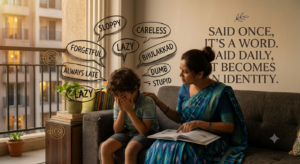
I wasn’t shocked by what I heard, because Kunal’s story is common. Children are called slow, dumb, careless, kalu, golu, chotu, hyper, talkative, lazy, and most of the time nobody means harm. It’s a joke, or a moment of frustration, or a hopeful push to make the child try harder. But a child doesn’t hear a joke or a strategy. A child hears a verdict from the people they trust most. Said once, it’s a word. Said daily, it becomes an identity. And when the words are spoken in front of relatives, friends or classmates, they stop being a label and become humiliation, which goes straight to the child’s self-esteem.

Schools can add to this without meaning to. When results are the easiest measure, the topper becomes the default choice for every co-curricular and extra-curricular activities, as if the highest scorer must be best at everything. Meanwhile, the child who writes beautifully or has a voice that could hold a hall is never asked. After a while, that child concludes, I’m not good at anything.

Even compliments can do damage. A friend of mine often says proudly, whenever her elder daughter is praised, “Yes, she looks like me. Per kya kare, choti wali to apni bua par hi chali gayi.” (But what to do, the younger one took after her aunt.) Imagine hearing that as the younger child. She may start wondering, Is something wrong with me? She may even resent her aunt and envy her sister. One casual line is enough to plant that doubt.

And the doubt grows. A child who is told who she is, again and again, starts to believe it. Her self-esteem drops, and her confidence shrinks with it. Speaking in front of others becomes frightening, and she learns that staying quiet is safer than trying. Years later, she is still chasing other people’s approval to prove the label wrong.

“A child may forget the occasion, but the words repeated by the people they trust can stay with them for years.”

The good news is that words can also build a child. So don’t humiliate the child, even when you are frustrated, because humiliation gets in the way of the child’s self-esteem and confidence. Instead of saying “You’re lazy and useless” (which attacks the child’s identity and hurts them), try “Your homework is incomplete, let’s make a plan to finish it” (which teaches a skill and protects the child’s dignity). We can also look for the strength inside the trait, because the “talkative” child may be a future speaker and the “shy” one a thoughtful observer. And we can share the stage, so that every child gets a chance to shine, not just the one who always wins.

So here is the question I leave with every parent and teacher: are we helping our children discover who they are, or are we repeatedly telling them who we think they are?

Dr. Daisaku Ikeda, a Japanese educator, said it best: “Every child is born with a unique mission. Our responsibility as parents and educators is not to make them like someone else, but to help them discover who they truly are and bring forth their unique potential.”

Kunal is no longer bhulakkad. He is a boy who stood on a stage and spoke.

Which word will your child carry?

My Daughter Is Not Distant… She Is Growing Up: How Mothers Can Bridge the Emotional Gap During Teenage Years -Vaishali (HonestMaa)

There was a time when my daughter would tell me everything.


What happened at school, whom she played with, what made her laugh, what made her cry—even the smallest things became stories she wanted to share with me.

And then, slowly, something changed.

Her answers became shorter. Her room became her favourite space. Sometimes, when I asked, “What happened? Why are you so quiet?” she would simply say, “Nothing, Maa.”


And I wondered, Why is my daughter not sharing things with me anymore? Am I losing my connection with her?


If u are a mother of a teenager, perhaps you have asked yourself these questions, too.


But what if our daughters are not moving away from us? What if they are simply growing into a new version of themselves—and we are still trying to connect with the little girls they used to be?

When Love Starts Sounding Like Interrogation


  1. As mothers, our questions come from love and concern.


“Where were you?”


“Who were you talking to?”


“Why didn’t you tell me earlier?”


“Why are you behaving like this?”


We ask because we care. We want our daughters to be safe, make good decisions and avoid the mistakes we might have made.


But sometimes, without realising it, our concern begins to sound like suspicion. Our questions begin to feel like an examination, and our advice arrives before our daughters have finished expressing themselves.


Imagine coming home after a difficult day, wanting someone to listen to you. Instead, you are immediately asked several questions and told what you should have done differently.


Would you feel like sharing more?


Our daughters can experience the same emotions.


The intention behind our words may be love, but the impact can sometimes be distance.


This doesn’t mean we should stop asking questions or setting boundaries. It means we must learn to communicate in ways that make our children feel safe enough to answer honestly.


Your Daughter Needs Space, Not Emotional Distance


Teenage years bring changes in emotions, friendships, identity and independence. Teenagers may need more privacy as they learn to understand themselves.


Their silence does not always mean disrespect. Their desire to spend time alone does not automatically mean they are hiding something. Sometimes, they simply don’t have the words to explain what they are feeling.


Instead of immediately asking, “What is wrong with you?”, try saying:


“I can see that you want some time to yourself. That’s okay, beta. Whenever you feel like talking, I am here.”


This simple sentence communicates something powerful: You don’t have to explain everything immediately to deserve my love.


Of course, respecting privacy doesn’t mean ignoring genuine safety concerns. Mothers can offer age-appropriate independence while maintaining clear, reasonable boundaries around safety, online interactions and responsibilities.


The goal is not to know every little detail of our daughters’ lives. The goal is to build a relationship in which they feel comfortable sharing what matters.


Four Small Changes That Can Bring You Closer


1. Listen before you advise.

When your daughter shares a problem, resist the urge to fix it immediately. Ask, “Do you want me to listen, or would you like my help finding a solution?”


2. Pause before reacting.

If she tells you something unexpected, take a breath. Your first reaction can determine whether she feels safe sharing something difficult with you again.


3. Replace interrogation with curiosity.

Instead of “Why didn’t you tell me?”, try, “Was there something that made it difficult for you to share this with me?”


4. Create connection without pressure.


Sit together while having snacks, go for a walk, cook something she enjoys or simply spend ten minutes talking without phones. Not every conversation needs a lesson, and not every moment needs a question.


Small, consistent moments of connection often matter more than one big emotional conversation.


Before You Ask Your Daughter to Change, Look Within


Sometimes, our children’s behaviour triggers our own fears.


Her silence may remind us of rejection. Her independence may make us feel less needed. Her disagreement may feel like a challenge to our parenting.


When these feelings arise, let’s pause and ask ourselves:


Am I responding to what my daughter is experiencing right now, or am I reacting to my own fear?


And if we react harshly, we can repair the moment.


“Beta, I was worried, but I realise I spoke in a way that may have hurt you. I’m sorry. I want to understand you better.”


An apology doesn’t reduce our authority. It teaches our daughters that relationships can survive mistakes and become stronger through repair.

Dear Maa, your daughter is growing up. She is learning to make decisions, understand her emotions and discover who she wants to become.


You may not always be the first person she tells everything to. Some days, she may need space. Other days, she may need your comforting presence without a single question.

You simply need to keep creating a relationship where love is not conditional on sharing everything, where mistakes are met with guidance rather than humiliation, and where difficult conversations do not automatically lead to judgment.


Your daughter may be growing into an independent young woman, but she still needs to know that she has a safe place in your heart.


And perhaps the most beautiful thing a mother can say is:

“Beta, I may not always understand everything you feel, but I will always be willing to listen, learn and grow with you.”

Because the goal is not to raise a daughter who tells us everything out of fear.

It is to raise a daughter who chooses to come to us because she feels safe, respected .

A JOURNEY FROM PRESSURE TO POSSIBILITIES


How Awareness, Acceptance, Acknowledgement, and Application Helped a Mother Rediscover Faith in Her Child

  1. 1. The Challenge: “Mera Beta Mere Haath Se Nikal Gaya”

“Ma’am, mera beta mere haath se nikal gaya!”

These words reflected a distressed mother’s anxiety about her Class XII son. His board and competitive examinations, including JEE Main, were approaching, yet he was spending increasing amounts of time on his mobile phone, struggling to focus and scoring poorly in coaching tests.

As a parenting coach, I wanted to understand what lay behind his behaviour rather than judge him solely on his academic performance.

After two sessions, I learned that the closure of the dummy school where he had spent much of his schooling, followed by a school change and an unfamiliar environment, had affected him deeply. Along with the challenges of adolescence, he was struggling to adjust and manage his studies.

  1. Awareness: Understanding Before Reacting

I helped the mother recognise how her anxiety was influencing her communication with her son. Repeatedly reminding him of lost time or saying, “Tumse nahi ho payega” and “Tum bas mobile mein lage raho, time waste karte raho” could further discourage him.

I told her, “Your goal is not to pass on your anxiety to your son. Your goal is to help him move forward from where he is today.”

With only two and a half months remaining, completing the entire syllabus was unrealistic. We needed to focus on what we could still achieve.

The shift was from asking, “Why is my child wasting time?” to asking, “What does my child need from me at this stage?”

  1. Acceptance: Starting Where the Child Is

Acceptance did not mean giving up academic expectations. It meant acknowledging the child’s present situation and working realistically from there.

We divided the remaining syllabus into a day-wise, marks-wise plan. Mother and son initially agreed to cover approximately 70% of the syllabus, prioritising important topics. This practical approach eased the mother’s anxiety, and she took leave from her public-sector job to support her son.

We shifted our attention from lost opportunities to the possibilities that remained.

  1. Acknowledgement: Recognising Effort and Potential

I encouraged the mother to avoid negative remarks and practise encouragement.

She called me daily to discuss her son’s routine. Although she often had complaints, she ended each call by telling me she had not said anything negative to him that day. I appreciated her efforts because she, too, was learning to change.

One day, she called me repeatedly while I was at a family gathering. She was crying because she had caught her son talking to a girl.

“Ye toh bigad gaya hai!” she exclaimed.

I laughed and said, “Congratulations!” I wanted her to view the incident differently rather than treat it as proof that her son was going astray. I advised her not to scold or taunt him and later discussed adolescence and the importance of trust.

I also explained that praise should not be limited to marks and achievements. We must acknowledge effort, progress, persistence, and the willingness to try again. Instead of saying only, “You scored well,” we can say, “I can see how much effort you put into preparing for this test.”

Gradually, the mother began recalling her son’s earlier achievements. She sent me photographs of his gold medal from the Class VIII Science Olympiad and other certificates. These memories helped her see beyond his current struggles and reconnect with his abilities.

Sometimes, a child needs an adult who believes in their potential until they can believe in it themselves.

  1. Application: Turning Awareness into Action

The mother began applying these learnings daily. She worked on her responses, avoided negative remarks, and encouraged her son while focusing on realistic goals and consistent progress.

By December, he had revised 50% of his Physics and Mathematics syllabus with help from his mother and Chemistry tutor. Although his pre-board results were not very good, we developed strategies for further preparation instead of allowing those marks to define his abilities.

The outcome was heartening. He cleared his Class XII board examinations with flying colours and secured admission to a good engineering college in Noida, in his preferred branch.

The Key Learning

 Change the Lens, Change the Possibilities

This journey was not just about academic success. It was about a mother learning to manage her anxiety, change her responses, and rediscover faith in her child.

Praise the effort. Acknowledge the progress. Guide the behaviour. Above all, keep believing in your child—even when circumstances seem unfavourable.

Sometimes, the most important change in a child’s life begins when a parent changes the way they see their child.

By

SHRADHA AGARWAL

HAPPY PARENTING HUB

9650996151


Picky Eating in Children: Before We Change the Menu, Let Us Understand the Child

“Just one more bite!”
“You haven’t eaten anything!”
“Why can’t you eat what everyone else is eating?”

For many parents, mealtimes become a daily negotiation. What begins as a concern about nutrition can slowly turn into frustration, anxiety, and a power struggle between the parent and the child.

But what if we pause and ask ourselves: Is my child refusing food, or is there something about the food that my child is finding difficult to accept?

As parents and parent coaches, we need to look beyond the plate and understand the child behind the behaviour.

Understanding the reason behind picky eating

Picky eating can range from a normal developmental phase to a more complex feeding difficulty.

Between 2 and 4 years of age, children commonly become selective about food as they develop independence and explore their preferences. However, significant food selectivity can emerge or become noticeable at a later age, too.

Some children have differences in sensory processing. The taste, smell, temperature, appearance, or texture of certain foods may feel overwhelming. A child may tolerate crunchy foods but reject soft ones, accept foods separately but refuse mixed dishes, or become distressed simply by the smell of a particular food.

Gustatory sensory processing relates to how the brain processes taste. Oral sensory sensitivities may also affect how a child experiences food inside the mouth.

Sometimes, what appears to be picky eating may be associated with autism spectrum disorder (ASD), attention-deficit/hyperactivity disorder (ADHD), anxiety, developmental differences, or avoidant/restrictive food intake disorder (ARFID). These conditions do not affect every child in the same way, and picky eating alone does not establish any diagnosis.

Medical causes such as constipation, reflux, dental pain, food allergies, oral-motor difficulties, and swallowing problems must also be considered.

Before treating a child as a typical picky eater, we must evaluate whether an underlying medical, developmental, sensory, or feeding-skill difficulty is present.

Ordinary picky eating or a feeding difficulty?

How do we know when to look beyond ordinary food preferences?

A child who dislikes a few vegetables but eats a reasonable variety of foods, grows appropriately, and participates comfortably in family meals may simply need time, patience, and repeated exposure.

However, professional assessment becomes important when a child:

  • Accepts only a very limited range of foods or gradually eliminates previously accepted foods.
  • Has strong sensory reactions to food smells, textures, temperatures, or appearances.
  • Gags frequently, struggles to chew, coughs or chokes while eating, or appears to have difficulty swallowing.
  • Has poor growth, nutritional deficiencies, persistent gastrointestinal symptoms, or concerns about adequate intake.
  • Experiences significant anxiety or distress around meals, or when food interferes with everyday functioning.

Depending on the presentation, a paediatrician may recommend assessment by a dietitian, speech and language therapist, occupational therapist, psychologist, or specialist feeding team.

The aim is not to label the child. It is to identify the reason behind the difficulty and provide appropriate support before the problem becomes more entrenched.

When the gag reflex becomes a barrier

Some children gag when a particular texture touches their tongue or enters their mouth. Others gag when they smell a food, see it on the plate, or anticipate being asked to eat it.

A gag reflex is a protective response. However, recurrent or exaggerated gagging may be associated with oral sensory sensitivity, oral-motor difficulties, previous unpleasant feeding experiences, or medical concerns.

It is important to distinguish taste-related sensory difficulties from gagging and swallowing problems. Although these can overlap, their management may differ.

What can parents do?

 

  1. Never force a bite. Pushing food into the mouth or insisting that the child swallow despite gagging can increase distress and food aversion.
  2. Start outside the mouth. Allow the child to look at, smell, touch, or help prepare the food without any expectation of eating it.
  3. Introduce gradual, manageable experiences. Depending on the child’s needs, begin with foods they already accept and explore small changes in appearance, temperature, or texture.
  4. Observe the triggers. Note which foods or textures lead to gagging, whether the reaction occurs before or during eating, and whether there are other symptoms.
  5. Seek appropriate assessment. A paediatrician can help identify medical causes and recommend a feeding specialist when needed. Frequent gagging, coughing, choking, or difficulty swallowing should not be managed simply by repeatedly exposing the child to the offending food.

There is no universal home exercise that can safely eliminate an exaggerated gag reflex. Management must be individualised.

 

Reintroducing foods: Patience before giving up

Have you offered a vegetable twice, watched your child reject it, and decided never to serve it again?

Children often need repeated, pressure-free exposure to become familiar with a food. It may take 10–20 exposures or more, although this is not a fixed rule and acceptance varies from child to child.

Start small. Let the child see the food, touch it, smell it, help wash it, or place it on the plate. Eating can come later.

You can also follow a practical meal-planning principle: repeat the same rejected food after the fourth meal rather than offering it at every meal. This is a flexible strategy, not a scientific rule. It gives the child some space while keeping the food familiar.

Offer a familiar, accepted food alongside the new food. Avoid pressure, bargaining, threats, and forcing the child to finish a portion.

For children with significant sensory or feeding difficulties, exposure must be adapted to their tolerance and professional guidance.

Predictability in unpredictability

Children need routine, but they also need opportunities to explore.

Maintain predictable meal and snack timings while introducing variety in manageable ways. A vegetable may be steamed one day and included in a familiar dish another day. Allow the child to participate in choosing or preparing food.

The aim is to create a balance: the child knows what to expect, yet has opportunities to discover something new.

Remember that predictability does not mean serving the same menu every day, and variety does not mean introducing several unfamiliar foods at once.

Encouragement and acceptance must go hand in hand

Encourage your child to explore, but accept that they may not be ready to taste something today.

Appreciate small steps: sitting at the table, touching a new food, smelling it, or taking a tiny bite. Avoid comparing siblings, shaming the child, or expressing disappointment over every rejected meal.

At the same time, acceptance does not mean abandoning structure. Parents can decide what food is offered, when meals happen, and where the family eats. The child can gradually learn to respond to hunger and fullness cues and decide how much to eat from the available choices.

Children with feeding disorders may need individualised support to ensure adequate nutrition and safe feeding.

Work on the emotional bond, not just the menu

Sometimes, our anxiety about a child’s eating becomes so intense that every interaction revolves around food.

The child may begin to associate mealtimes with pressure, disappointment, or conflict. Gradually, even the sight of a plate may trigger resistance.

Can we create opportunities to connect outside mealtimes?

Play together. Listen to their stories. Laugh, talk, and enjoy shared experiences without turning every conversation into advice or correction.

Let your child know that your love is not dependent on how much they eat, how well they perform, or how easily they follow instructions.

Unconditional love is not a reward for cooperation. It is the foundation of emotional security.

A secure emotional bond does not automatically resolve sensory or medical feeding difficulties, but it helps create a supportive environment in which the child can receive the care and guidance they need.

A final thought for parents and parent coaches

Picky eating requires patience, observation, consistency, and sometimes professional support. There is no single strategy that works for every child.

Our first responsibility is to understand whether we are dealing with a developmental phase, a sensory challenge, an underlying medical concern, or a more complex feeding difficulty. Only then can we decide which management approach is appropriate.

So, the next time your child pushes the plate away, pause before reacting.

Instead of asking, “Why won’t my child eat?”, try asking, “What might my child be experiencing, and how can I help?”

Because our goal is not merely to raise children who finish their plates. It is to nurture children who develop a healthy relationship with food, their bodies, and the people who care for them.

A gentle reminder: Sometimes, the first step towards better eating is not changing the food on the plate. It is changing how we understand the child sitting in front of us.

Latest Posts